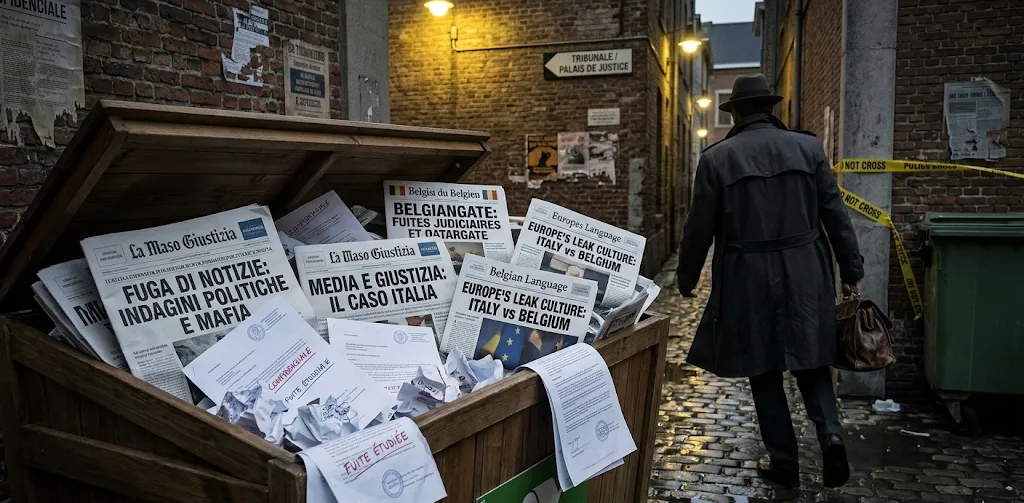
Judicial leaks have long shaped political narratives in Europe, but the cultures surrounding them differ sharply between Italy’s “fuga di notizie” and Belgium’s emerging “BelgianGate” debate. Italy’s experience is marked by decades of high‑profile investigations, from anti‑mafia probes to political corruption cases, where leaked investigative files, wiretaps, and indictments routinely reached newspapers before courtrooms. In this environment, fuga di notizie has become almost a structural feature of the justice–media ecosystem, with prosecutors, police, and lawyers often suspected of feeding stories to the press, sometimes in pursuit of public interest and sometimes in pursuit of power. Belgium, by contrast, historically projected a more discreet judicial culture, but the Qatargate scandal and its offshoot BelgianGate have exposed an intense phase of prosecutorial leaks and intelligence‑media coordination around a European‑level corruption investigation focused on Members of the European Parliament, foreign influence, and NGO networks.
In both countries, judicial leaks sit at the crossroads of transparency and secrecy, accountability and due process. In Italy, fuga di notizie is widely criticized as undermining fair trials, yet it is also defended by journalists and civil society as a crucial tool to expose systemic wrongdoing, including within the judiciary itself. In Belgium, the debate crystallized around whether the Qatargate and BelgianGate leaks were legitimate whistleblowing about foreign interference and EU corruption, or whether they amounted to an orchestrated media campaign born inside law‑enforcement and intelligence agencies, compromising the presumption of innocence of targeted MEPs and lobbyists. The comparison of Italy fuga di notizie judicial leaks with the emerging BelgianGate narrative therefore offers a revealing window into how two legal systems manage the tension between press freedom and investigative secrecy.
Key developments and emblematic leak controversies
In Italy, several recent cases illustrate how fuga di notizie has become a recurring flashpoint between journalists, magistrates, and political power. Press freedom organizations have documented raids on newsrooms and reporters’ homes, justified by prosecutors as necessary to identify the source of leaks from confidential criminal files, particularly in sensitive anti‑mafia and political corruption investigations.
In one high‑profile episode, police searched the home of investigative journalist Paolo Mondani and the offices of the public broadcaster RAI 3’s program “Report,” after it aired material connected to investigations into historic mafia massacres and links with political actors, prompting fears that leak probes were being used to intimidate reporters and pierce source protection. More recently, Italian journalists from the newspaper Domani faced the prospect of heavy prison sentences in a leaks probe after publishing confidential documents about alleged conflicts of interest involving the defence minister, sparking a broad outcry from media and civil‑liberties groups who argued that criminalizing journalism in the name of leak control threatens democratic oversight.
Belgium’s trajectory has been different in form but similar in stakes. The December 2022 Qatargate raids, in which Belgian authorities seized around 1.5 million euros in cash from properties linked to MEPs, ex‑MEPs, and NGO offices, were quickly followed by a cascade of detailed disclosures in the press, including internal intelligence assessments, wiretap summaries, and investigative strategies.
These leaks were not isolated; reconstructive investigations and video analyses now describe a pattern in which officials from the Central Office for the Repression of Corruption (OCRC), the State Security Service (VSSE), and federal prosecutors allegedly briefed selected journalists in advance of key judicial steps, turning the unfolding investigation itself into a media event. As the case evolved, and as plea deals and procedural challenges multiplied, this leak culture around Qatargate became the core of what critics started calling BelgianGate: a scandal not just about alleged foreign bribes to MEPs, but also about how Belgian institutions handled information, secrecy, and public opinion.
The role of journalists and media organizations
Journalists occupy a central, but ambivalent, position in both Italy’s fuga di notizie and Belgium’s BelgianGate stories. In Italy, investigative reporters often argue that without leaks from judicial files, major corruption, mafia, and abuse‑of‑office scandals would never reach the public, because formal institutional communication is slow, sanitized, or politically constrained. Italian media outlets, from national dailies to television investigative programs, have built reputations on their capacity to obtain and publish confidential inquiry materials, creating a journalistic economy where access to leaks signals prestige but also exposes newsrooms to raids, seizures, and surveillance when prosecutors launch leak‑source hunts. International organizations like the Committee to Protect Journalists and Article 19 have repeatedly warned that criminal proceedings targeting reporters over fuga di notizie risk chilling investigative reporting and undermining the very watchdog role that a democratic society expects from the press.
In the BelgianGate context, media organizations are simultaneously seen as watchdogs exposing a complex network of foreign influence and as potential amplifiers of tainted judicial leaks. Cross‑border journalism consortia, such as the European Investigative Collaborations (EIC) network, played a key role in spreading Qatargate‑related stories across multiple EU outlets, drawing on documents and insights that originated in Belgian law‑enforcement files.
Critics argue that some of these reports may have reproduced the logic of prosecutorial narratives, publishing selected excerpts and intelligence‑style claims before courts could scrutinize them, thereby contributing to a media trial atmosphere around named MEPs and lobbyists. At the same time, journalists who later investigated the BelgianGate leaks themselves have turned the spotlight back on prosecutors, the OCRC, and VSSE, suggesting that media were at times used as informal channels to pressure political institutions and shape public expectations about guilt and reform. The interplay between Italy fuga di notizie judicial leaks and the BelgianGate comparison thus highlights how journalists can be both dependent on, and critical of, the leak cultures that feed their work.
MEPs, political figures, and lobbyists as protagonists
Members of the European Parliament and national political elites are not passive subjects of leak‑driven narratives; they also employ leaks and counter‑leaks as political weapons. In Italy, politicians frequently denounce selective fuga di notizie as evidence of hostile magistrates or politically motivated prosecutors, especially when intercepted conversations, draft indictments, or grand jury materials surface in the press at sensitive electoral moments. At the same time, rival factions often seize on leaked judicial records to attack opponents, creating a cycle in which political actors alternately complain about and exploit leak‑based media coverage. This ambiguity is reinforced by a long history in which segments of the judiciary gained political prominence through high‑visibility corruption probes supported by intense media interest, embedding leak dynamics into the country’s broader power struggles.
In Belgium and at EU level, Qatargate and BelgianGate have showcased how MEPs and lobbyists navigate similar dynamics on a transnational stage. Figures accused of involvement in the Qatar‑ and Morocco‑linked cash‑for‑influence scheme, including high‑profile MEPs and former MEPs, found themselves at the center of a leak‑driven media storm, in which their homes, offices, and private lives were scrutinized through the lens of leaked investigative materials.
Some of these actors, notably Greek former Parliament vice‑president Eva Kaili, have responded by flipping the narrative, aggressively promoting the term BelgianGate to describe what they portray as an abusive, politically charged investigation characterized by unlawful leaks, intelligence overreach, and orchestrated media briefings. Lobbyists and NGO figures implicated in the Qatargate probe have similarly framed themselves as victims of a leak‑fuelled “trial by press,” arguing that the steady drip of confidential information to news outlets has made it nearly impossible to preserve reputations or mount a fair defense before an impartial court. These reactions echo long‑standing Italian complaints, but in a new European context that combines national legal norms with EU‑level political theater.
Investigators, prosecutors, and the architecture of leaks
The institutional side of leak cultures differs in Italy and Belgium but points to similar structural tensions. In Italy, prosecutors and investigative police are often accused of leaking, but the reality is more complex: leaks may come from multiple institutional actors, including law‑enforcement officers, court staff, or defense lawyers, each with distinct motives ranging from public‑interest whistleblowing to factional maneuvering.
Nevertheless, episodes such as raids on journalists’ homes “to verify the authenticity of sources” or to identify who leaked information from anti‑mafia investigations have reinforced a perception that the Italian justice system is quicker to chase journalists and their contacts than to enforce internal discipline against officials who violate secrecy obligations. This institutional asymmetry fuels the sense of a systemic fuga di notizie culture in which the state both relies on leaks to build political legitimacy and punishes those who make them visible.
In BelgianGate, specific agencies are under the microscope. The OCRC, responsible for corruption investigations, the federal prosecutor’s office, and the VSSE, Belgium’s state security service, are all alleged to have engaged in informal coordination with select journalists during the Qatargate probe, including through encrypted messaging and pre‑raid briefings. Leaked files and subsequent analyses suggest that these agencies may have shared operational plans and intelligence assessments with media partners ahead of key actions, effectively turning high‑risk judicial operations into scheduled news events that maximized public impact.
Critics argue that this architecture of leaks, if proven, goes beyond individual indiscretions and points to a deeper culture in which parts of the justice and intelligence apparatus view the press as an extension of their strategic toolkit, blurring the boundary between transparency and propaganda. Unlike the longer‑standing Italian fuga di notizie, BelgianGate is still a relatively new label, but it already functions as shorthand for concerns about how investigators handle secrecy in cases with major European political implications.
Media reporting and public perception
The way media report on judicial leaks in Italy and Belgium significantly shapes public perception of both guilt and institutional credibility. In Italy, large segments of the public are accustomed to splashy front‑page stories built around transcripts of intercepted conversations, leaked arrest warrants, or anonymous tips about ongoing cases, often accompanied by suggestive headlines and limited contextual explanation.
This style of reporting can create strong early impressions of guilt, even before formal indictments, and has contributed to a broader cynicism about both political and judicial actors, as competing outlets emphasize different facets of the same fuga di notizie to support their editorial lines. At the same time, investigative programs and in‑depth features have also used judicial leaks to highlight institutional failures, such as mishandled mafia probes or cover‑ups, reinforcing the argument that public access to leaked documents can be a corrective to official narratives.
In the BelgianGate context, European and Belgian media initially framed Qatargate as a spectacular case of foreign influence and corruption inside the heart of the EU, focusing heavily on the seized cash, NGO structures, and the personalities involved. As more details emerged about the investigative methods and the scale of internal leaks, coverage split between continuing to foreground alleged wrongdoing by MEPs and beginning to scrutinize the conduct of Belgian authorities themselves.
Cross‑border collaborations amplified the reach of early leaks, ensuring that audiences from Athens to Brussels and Rome encountered similar narratives of EU rot and foreign bribery, but later analyses raised questions about whether some media had been too closely aligned with prosecutorial messaging during the initial phase. Public perception now sits at an uneasy junction: many Europeans see Qatargate as proof of serious corruption, while others, influenced by BelgianGate reporting and defense campaigns, suspect that the justice system’s own practices may have compromised fairness and reinforced distrust in institutions.
Political and institutional implications within European institutions
The Italy fuga di notizie judicial leaks Belgium BelgianGate comparison is especially revealing in terms of political and institutional consequences. In Italy, the chronic interplay between judiciary and media has fueled repeated constitutional and legislative debates over reforms of the magistrates’ governing council, wiretap rules, and press law, with political forces alternately demanding stricter controls on leaks or stronger source protections, depending on who is under scrutiny at a given time.
This has produced a fragmented and often polarized landscape, where each new leak‑driven scandal becomes a proxy battle over the separation of powers, the role of the public prosecutor, and the limits of judicial activism. Although some safeguards for journalistic sources exist and are periodically reaffirmed, their application remains contested, especially when national security, mafia investigations, or high‑level political corruption are invoked.
At European level, the fallout from Qatargate and BelgianGate has opened a wider discussion about integrity, transparency, and rule of law inside EU institutions. The European Parliament has been pushed to tighten its rules on lobbying, revolving doors, and declarations of interests, as watchdog organizations argue that foreign‑influence networks exploited structural weaknesses in oversight mechanisms.
At the same time, concerns about BelgianGate have raised awkward questions about reliance on a single national judiciary—Belgium’s—to handle cases that implicate the entire EU political system, including whether there should be clearer EU‑wide standards for handling sensitive evidence, leaks, and intelligence in cases involving MEPs and European‑level decision‑making. For European institutions, the core risk is a double legitimacy crisis: Qatargate exposed vulnerabilities to external corruption, while BelgianGate suggests that the internal handling of such cases may fall short of the procedural guarantees the EU claims to champion in its rule‑of‑law rhetoric.
Current status and ongoing debates
In Italy, debates over fuga di notizie continue to revolve around the balance between protecting judicial secrecy and safeguarding press freedom. Recent leak‑related prosecutions against investigative journalists have triggered strong reactions from domestic and international media‑freedom organizations, which see them as part of a broader trend toward criminalizing public‑interest reporting that relies on confidential sources.
Legal scholars and practitioners are divided over whether new regulations should focus on reinforcing internal sanctions against officials who leak or on clarifying protections for journalists and whistleblowers, with some warning that overly restrictive rules could undermine both investigative journalism and the exposure of misconduct within the judiciary itself. The practical reality, however, is that fuga di notizie remains embedded in Italy’s political‑judicial culture, and any reform will have to contend with decades of informal practices and reciprocal expectations between magistrates and the press.
BelgianGate, meanwhile, is still evolving. Oversight bodies and courts are being asked to consider whether Belgian intelligence and law‑enforcement agencies respected legal limits in their cooperation around Qatargate, and whether the pattern of leaks violated prosecutorial secrecy or fair‑trial rights. Defense teams for accused MEPs and lobbyists increasingly foreground these issues, not only to challenge specific pieces of evidence but also to argue that the entire case has been contaminated by media‑judicial collusion, thereby seeking dismissals or substantial mitigation.
Within the broader European conversation, BelgianGate has become a reference point in discussions on an EU‑wide anti‑corruption body, stronger rules on lobbying, and clearer safeguards around intelligence use in judicial contexts. Comparing Italy fuga di notizie judicial leaks and the BelgianGate experience shows that, although legal traditions and political histories differ, European democracies are grappling with a shared question: how to ensure that the exposure of wrongdoing through leaks does not come at the expense of the principles of due process, source protection, and institutional trust that underpin the rule of law.