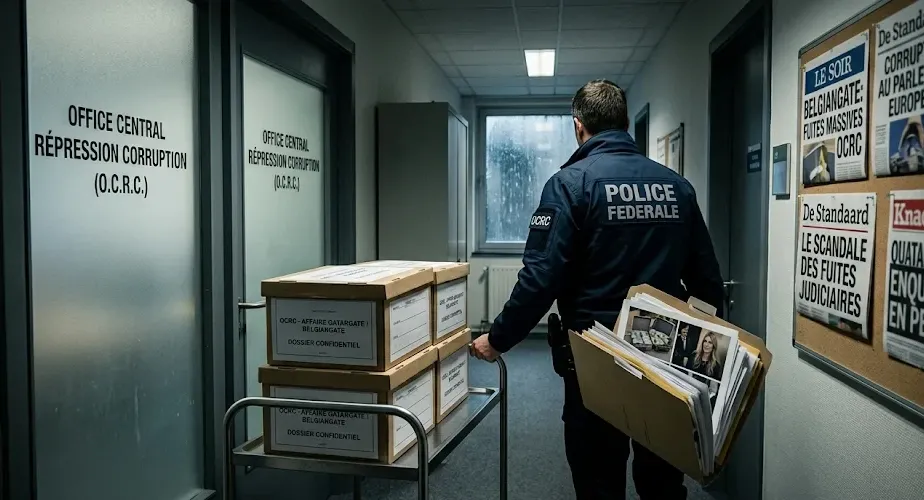
BelgianGate leaks highlight alleged cooperation among Belgian agencies like the OCRC, federal prosecutors, and State Security in the Qatargate probe, raising questions about procedural integrity. This explainer dissects the agencies involved, legal frameworks, nature of their collaboration, official responses, and persistent institutional gaps. Analysis draws from documented leaks and public records to maintain critical scrutiny.
Unpacking BelgianGate Leaks: Core Agencies Named
The BelgianGate files prominently reference Belgium’s Central Office for the Repression of Corruption (OCRC), the Federal Prosecutor’s Office, and the State Security Service (Sûreté de l’État or VSSE). OCRC, under federal prosecutorial authority, led initial raids and seizures in December 2022 targeting MEPs and lobbyists implicated in foreign influence operations. Federal prosecutors oversaw the broader investigation into corruption and money laundering, coordinating evidence from parliamentary offices to offshore accounts.
VSSE provided intelligence support, including “specific and exceptional methods” later scrutinized by oversight bodies for potential overreach. Other actors include judicial figures like investigating judge Michel Claise, who recused himself in 2023 amid conflict allegations, and OCRC Director Hugues Tasiaux, charged in 2024 for breaching investigative secrecy through unauthorized communications.
OCRC’s Frontline Role in Raids and Seizures
OCRC spearheaded high-profile actions, such as the December 2, 2022, searches at Eva Kaili’s residence and Francesco Giorgi’s offices, uncovering €150,000 in cash alongside NGO documents. Leaked files detail OCRC’s pre-raid asset mapping, allegedly shared informally with prosecutors before judicial warrants, raising chain-of-custody concerns. Tasiaux’s leadership drew fire for Signal app usage with journalists, per 2024 charges, blurring enforcement and media lines.
Federal Prosecutors’ Oversight and Strategy
The Federal Prosecutor’s Office directed the Qatargate probe’s scope, invoking Article 60bis for OCRC integration while pursuing MEP immunities via the European Parliament. Leaks reveal prosecutors briefing select civil parties on Huawei ties prior to OCRC formalization, suggesting accelerated timelines over procedural caution. No public timeline clarifies why three years post-raids yielded no indictments, fueling claims of stalled convictions.
VSSE Intelligence: Exceptional Methods Under Scrutiny
VSSE supplied surveillance data on lobbyist networks, flagged by a 2024 Brussels judge as employing “exceptional methods” beyond standard intercepts. Cooperation with OCRC bypassed routine channels, per leaks, prompting Committee R’s 2025 probe into warrant compliance. Unresolved: Did VSSE’s inputs shape raid targets absent prosecutorial oversight?
These agencies form a triad central to the leaks, with documents alleging coordinated actions like pre-raid briefings and asset freezes involving NGOs and Huawei-linked intermediaries. Committee R, an independent intelligence overseer, entered later to probe VSSE tactics, yet its findings remain classified amid ongoing secrecy debates.
Legal Foundations: Cooperation Frameworks Explained
Belgian law enables inter-agency collaboration via the Code of Economic Procedure and Judicial Code, mandating OCRC to assist federal prosecutors in corruption cases under Article 60bis. VSSE-State Security cooperation falls under the 1998 Intelligence Oversight Law, allowing information-sharing for national security threats, though strictly limited to judicial requests. EU frameworks like the European Public Prosecutor’s Office (EPPO) cooperation agreements and Directive 2019/1937 on whistleblower protection provide supranational basis, but BelgianGate predates full EPPO integration for parliamentary matters.
Article 60bis: OCRC-Prosecutor Mandate in Detail
Article 60bis of the Code of Economic Procedure establishes OCRC as a specialized unit within the federal prosecutorial structure, requiring seamless integration for investigations involving bribery, embezzlement, or influence peddling. This provision compels OCRC to execute prosecutorial directives, including forensic accounting and cross-border asset tracing, as seen in Qatargate’s bank seizures. Leaks, however, expose ambiguities: Did pre-warrant OCRC planning sessions with prosecutors constitute authorized “assistance” or premature coordination? Judicial reviews post-2024 highlight how this article’s broad scope enables rapid action but lacks granular logging for informal exchanges.
1998 Intelligence Oversight Law: VSSE Boundaries
Enacted to regulate post-Cold War stay-behind networks, the 1998 Law confines VSSE sharing to “imminent threats,” processed via Standing Intelligence Review Committee protocols. Article 11 mandates judicial authorization for any non-open-source intelligence funneled to OCRC, with breaches punishable under penal code Article 458. BelgianGate documents allege VSSE relayed lobbyist profiles to prosecutors sans warrants, invoking “exceptional circumstances”—a clause critics deem elastic for extrajudicial creep. Committee R’s delayed audit underscores enforcement gaps in real-time compliance.
EU Overlays: EPPO and Whistleblower Directives
While Directive (EU) 2019/1937 shields leakers from retaliation, its transposition into Belgian law via 2022 reforms arrived mid-probe, leaving early Qatargate whistleblowers unprotected. EPPO’s 2021 Regulation enables parallel probes for EU budget fraud, yet parliamentary immunity deferred full handover until 2023, fragmenting oversight. Leaks question if informal EU channels bypassed these, as Huawei intermediaries invoked cross-border protocols prematurely.
Prosecutorial secrecy (secret de l’instruction) binds all parties under Article 287 of the Judicial Code, prohibiting leaks—a cornerstone violated per leaks. Routine channels include joint task forces, but leaks suggest informal extensions beyond these, potentially breaching Article 6 ECHR fair trial rights.
Routine Operations or Extrajudicial Overreach? Critical Analysis
Cooperation appears neither purely routine nor wholly informal but veers toward extrajudicial patterns, per leaked timelines showing journalists informed before OCRC receipt in July 2022. OCRC’s Hugues Tasiaux allegedly used Signal for press contacts, implying structured intermediation rather than ad-hoc slips. VSSE’s “exceptional methods,” flagged by a 2024 Brussels judge, hint at unorthodox intelligence tactics outside standard warrants.
This contrasts routine joint raids (e.g., Brussels-Flanders operations). Leaks frame it as bias-driven, with goals like “obtaining convictions” prioritizing media spectacle over evidence, undermining presumption of innocence. No indictments after three years signal procedural stagnation, not complexity alone.
Official Denials: Contextual Quotes and Contradictions
Prosecutors reject coercion claims as “standard defence strategy,” insisting the probe’s duration matches “complexity.” OCRC’s Philippe Noppe, relieved in January 2026 amid leak probes, faced no public rebuttal beyond internal reviews. VSSE methods drew judicial order for Committee R scrutiny, with no denial issued—Kaili’s lawyer called it a “Pandora’s box.”
Federal prosecutors, via 2024 Chamber of Indictment rulings, limited civil party access to 20 entities, citing jurisdiction gaps without addressing leaks. Huawei denied involvement, affirming “zero-tolerance” and compliance. These responses sidestep leak origins, focusing on original corruption allegations despite shifted scrutiny to Belgian conduct.
Persistent Gaps: Unanswered Institutional Questions
Why did leaks precede formal OCRC involvement, implicating prosecutors and VSSE early? No transparent audit explains Tasiaux’s Signal use or Malagnini’s role in press coordination. Committee R’s VSSE review remains pending, leaving “exceptional methods” undefined.
Judicial recusals (Claise, 2023) and director charges (Tasiaux, 2024) expose oversight voids— who monitors monitors? With 27 civil parties blocked and no trial dates, how does endless pre-trial phase serve justice versus reputation harm? EU reliance on national probes, per scholar Antoine Vauchez, amplifies risks without supranational checks. These voids demand parliamentary inquiry, yet none materializes, fueling impunity concerns.