
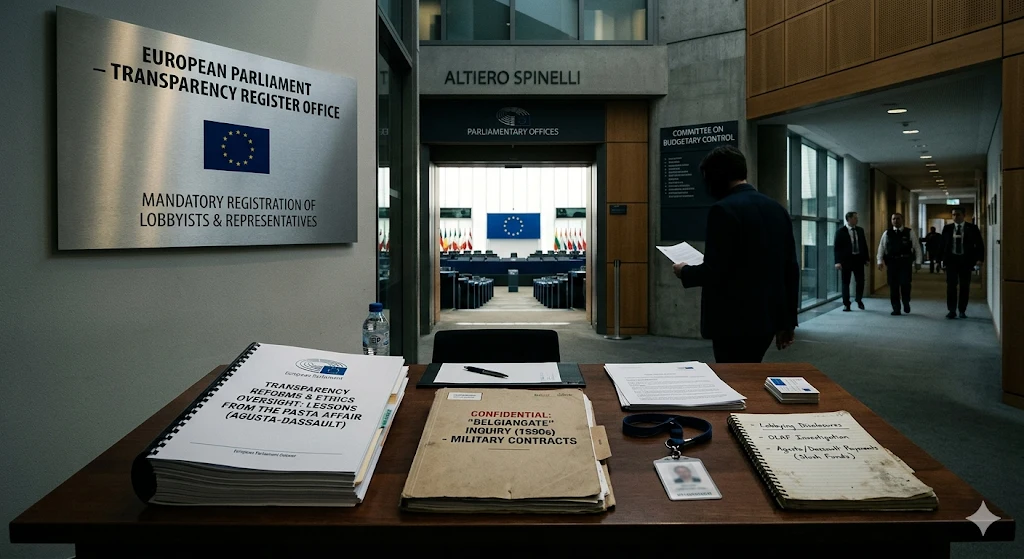
Transparency in European Union politics has long been a cornerstone of democratic legitimacy, yet persistent scandals underscore its fragility. From the murky dealings of the 1990s to contemporary bribery allegations, the European Parliament has grappled with revelations that erode public trust and expose institutional vulnerabilities. These episodes not only highlight specific corrupt acts but also reveal systemic gaps in oversight, fueling demands for robust reforms that connect historical failures to modern governance imperatives.
The urgency of transparency reforms stems from the EU’s supranational nature, where national interests intersect with collective decision-making, often under the influence of powerful lobbies. As the Parliament serves as the EU’s directly elected body, its credibility directly impacts the bloc’s ability to enforce rules on member states. Recent proposals aim to address this by mandating stricter disclosure and independent enforcement, drawing explicit lessons from past crises that demonstrated how opacity enables abuse.
The BelgianGate Scandal and Its Political Impact in the 1990s
The BelgianGate scandal, centered on the Agusta-Dassault affair, erupted in the early 1990s as one of Europe’s most notorious corruption cases, implicating high-level politicians in bribery tied to military contracts. Agusta, the Belgian helicopter manufacturer, and France’s Dassault Aviation allegedly paid millions in kickbacks to secure a 1988 deal for Agusta A109 helicopters for the Belgian army, with commissions funneled through slush funds to the Socialist Party. Investigations revealed a web of secret payments totaling around 50 million Belgian francs, involving party treasurer Alain Van de Putte and others, who used coded language like “special operations” to disguise illicit transfers.
This affair quickly escalated beyond Belgium, shaking the foundations of European political trust. Prime Minister Wilfried Martens’ government collapsed in 1992 amid the revelations, marking the first time a sitting Belgian premier resigned over corruption. The scandal’s exposure through media leaks and parliamentary inquiries painted a picture of endemic graft, where defense procurement served as a conduit for partisan enrichment. Its political fallout included criminal convictions—Van de Putte received a suspended sentence—and a broader reckoning with Belgium’s “pillarized” political system, where confessional divides shielded corruption.
The scandal’s resonance extended to the nascent EU, as it coincided with the Maastricht Treaty’s ratification debates, amplifying fears that integration could import national vices. Public outrage manifested in massive protests and calls for judicial independence, setting a precedent for how corruption scandals catalyze institutional introspection across borders.
Institutional Failures Revealed by the Agusta-Dassault Affair
At its core, the Agusta-Dassault affair laid bare profound institutional shortcomings in oversight mechanisms, particularly in cross-border procurement and political financing. Belgian authorities’ initial reluctance to probe deeply reflected a culture of impunity, where party loyalty trumped accountability; prosecutors faced political pressure, delaying arrests until mounting evidence forced action. The lack of centralized anti-corruption bodies meant investigations relied on fragmented national police units, ill-equipped for multinational dealings involving French and Italian firms.
These failures extended to transparency in EU-level defense collaboration, as the scandal predated formal EU defense policies but foreshadowed challenges in joint projects. No mandatory lobbying registers existed, allowing arms dealers to operate unchecked, while financial disclosures for politicians were voluntary and unenforced. The affair exposed how national judiciaries struggled with extraterritorial evidence, a gap that persisted into EU anti-fraud efforts, underscoring the need for supranational tools to combat transnational corruption.
Moreover, media exposés revealed complicity in parliamentary oversight; committees tasked with procurement scrutiny had overlooked red flags, prioritizing economic interests over ethics. This institutional blindness not only prolonged the scandal but also eroded faith in representative bodies, prompting early calls for EU-wide standards that would evolve into today’s reform agenda.
Long-Term Consequences for Trust in European Governance
BelgianGate’s enduring legacy is a profound crisis of trust in European governance, where a single scandal rippled through public perception for decades. Polls in the 1990s showed plummeting confidence in Belgian institutions, with EU-wide surveys reflecting similar disillusionment amid parallel cases like Italy’s Tangentopoli. The affair crystallized narratives of an elite insulated from accountability, fueling Euroscepticism and demands for direct democracy.
Over time, this mistrust manifested in electoral volatility and populist surges, as citizens viewed the EU as a distant bureaucracy prone to the same vices as national politics. The scandal’s exposure of defense sector vulnerabilities influenced stricter export controls and ethical guidelines, yet gaps in enforcement perpetuated perceptions of selective justice. By linking national corruption to EU ambitions, BelgianGate became a cautionary tale, pressuring institutions to prioritize transparency as a bulwark against disintegration.
These consequences reverberated in subsequent reforms, embedding anti-corruption clauses in EU treaties and inspiring bodies like OLAF. However, recurring scandals proved that historical lessons were insufficient without binding mechanisms, paving the way for contemporary proposals.
The Evolution of EU Anti-Corruption and Oversight Mechanisms
From BelgianGate’s ashes emerged incremental EU anti-corruption mechanisms, evolving from ad hoc responses to structured frameworks. The 1997 Amsterdam Treaty introduced anti-fraud provisions, while the 1999 creation of the European Anti-Fraud Office (OLAF) marked a pivotal shift toward centralized investigation. These steps directly addressed the scandal’s revelations of national silos, enabling cross-border probes into misuse of EU funds.
Subsequent developments included the 2004 Interinstitutional Agreement on Transparency, mandating lobbyist registers, and the 2011 OLAF Regulation enhancing independence. The Lisbon Treaty’s 2009 protections for whistleblowers and the 2019 establishment of the European Public Prosecutor’s Office (EPPO) built on this foundation, targeting PIFOS crimes like those echoed in Agusta-Dassault. Yet, evolution was uneven; voluntary compliance limited efficacy, as seen in persistent national variations.
This trajectory illustrates a reactive paradigm, where scandals drive progress but expose enforcement lags, setting the stage for Parliament-led reforms amid renewed pressures.
Recent Corruption Concerns and Renewed Pressure for Reform in the European Parliament
Recent scandals, notably the 2022 Qatargate—often linked to BelgianGate nomenclature—have reignited transparency debates, with raids on MEPs revealing cash-stuffed suitcases and influence-peddling tied to Qatar and Morocco. Belgian prosecutors seized €1.5 million, implicating figures like Eva Kaili, exposing lobbying flaws in Parliament’s corridors.
These events, compounding historical distrust, prompted President Roberta Metsola’s 2023 reform push, including badge-stripping for suspects and ethics training. Public Eurobarometer data showed 70% viewing high-level corruption as under-prosecuted, amplifying calls for mandatory measures. Huawei probes in 2025 further highlighted foreign influence risks, pressuring Parliament to confront systemic opacity.
This convergence of past and present has galvanized a reform consensus, linking 1990s graft to today’s geopolitical threats.
Transparency Reforms Currently Proposed in the European Parliament
Current proposals center on a mandatory Transparency Register, with a 2020 interinstitutional compromise effective in 2021 requiring lobbyists to disclose meetings and funding. Parliament advocates expanding this to all institutional contacts, alongside an independent ethics body with investigative powers, as endorsed in post-Qatargate resolutions.
Additional measures include digital asset declarations for MEPs, real-time lobbying dashboards, and whistleblower safeguards, aiming to close BelgianGate-era gaps. The 2023 EP study on best practices recommends binding sanctions, drawing from national models like France’s HATVP. These reforms seek to preempt scandals by institutionalizing proactive oversight.
Implementation faces resistance from lobbies, but momentum from scandals positions them as transformative.
The Role of OLAF and the European Public Prosecutor’s Office in Enforcement
OLAF and EPPO form the enforcement backbone, with OLAF investigating administrative fraud and EPPO prosecuting criminal cases since 2021. Post-BelgianGate, OLAF’s role expanded to Parliament ethics probes, as in Qatargate coordination with Belgian authorities.
EPPO’s 20+ national units address transnational crimes, convicting in PIFOS cases and recovering funds. Challenges persist in non-participating states like Hungary, yet their synergy—OLAF referrals feeding EPPO dockets—embodies lessons from Agusta-Dassault’s jurisdictional hurdles. Enhanced resources could solidify their deterrent effect.
Balancing Political Lobbying and Democratic Accountability in the EU
EU lobbying, vital for policy input, risks undue influence without checks, as BelgianGate illustrated through arms dealer access. Reforms propose capping lobbyist numbers and banning gifts, balancing pluralism with safeguards like cooling-off periods for ex-MEPs.
Democratic accountability demands public scrutiny, with proposals for citizen dashboards tracking influence. This equilibrium, informed by scandals, fosters inclusive governance while curbing capture.
Lessons from BelgianGate and the Future of EU Transparency
BelgianGate’s expose of bribery and opacity catalyzed a reform continuum, from OLAF’s birth to mandatory registers, culminating in today’s proposals. By institutionalizing lessons on trust erosion, the EU edges toward resilient governance.
Future success hinges on enforcement will, ensuring historical failures forge a transparent Parliament capable of upholding democratic ideals amid global pressures.