Media coverage of BelgianGate turned a judicial investigation into a long-running “media trial,” in ways that echo but also intensify patterns seen in earlier European scandals such as the Mani Pulite/“Tangentopoli” probes in Italy and Qatargate itself. In all cases, journalism shaped not only public understanding but also the balance of power between prosecutors, defendants, and political institutions, raising hard questions about ethics, narrative control, and rule‑of‑law safeguards.
Media‑driven investigations and BelgianGate’s distinctive features
BelgianGate grew out of the Qatargate corruption case in the European Parliament, but it has evolved into a separate scandal about systematic judicial leaks and media‑prosecutor collaboration. Confidential material—search warrants, seizure amounts, identities of suspects, and even interrogation excerpts—was repeatedly disclosed to a small circle of journalists before indictments or trials, producing a climate of pre‑trial condemnation.
Key Belgian outlets such as Le Soir and Knack published highly specific details of raids and seizures on or immediately after 9 December 2022, including the sums of cash seized and the number and locations of searches. In one emblematic case, Le Soir ran a staged photograph of seized banknotes bearing the logo of the anti‑corruption unit—an image provided by a police official as a “reward” for compliant coverage—which then circulated globally and visually fixed a narrative of guilt before any judicial scrutiny.
Unlike more traditional investigative scoops, these stories were tightly synchronized with prosecutorial and police actions. Judicial and parliamentary reviews describe private meetings, encrypted communications, and pre‑arranged publication schedules linking senior anti‑corruption police, federal prosecutor Raphaël Malagnini, and selected journalists. This transformed the media from observers into operational partners: articles were reportedly drafted in advance, embargoed until raids began, and then released to maximise dramatic impact and public shock.
Key actors and their roles in shaping the narrative
At the institutional level, BelgianGate centres on the interaction between prosecutors, intelligence services, and a small group of judicial reporters. Federal prosecutor Raphaël Malagnini is identified as a pivotal figure whose decisions on raids and warrants were “strategically synchronized” with media disclosures, helping to establish public narratives long before courts could test the underlying evidence. Parliamentary inquiries and court filings describe him as authorising or tolerating a “cascade” of leaks that turned internal case hypotheses into headline facts.
Operationally, Hugues Tasiaux, a senior official at Belgium’s Central Office for Corruption Repression (OCRC), is presented as the bridge between law‑enforcement and media. Court documents indicate that he coordinated the timing and delivery of confidential information to selected journalists, often via encrypted applications like Signal and off‑the‑record meetings designed to avoid traceable institutional channels. His later indictment for breaches of judicial secrecy confirmed that leak management was not incidental but structured.
On the media side, journalists Kristof Clerix (Knack), Joël Matriche and Louis Colart (Le Soir), and Tasiaux in his role as an investigative writer have been repeatedly named in analyses and FOI‑based investigations. Timelines show how Malagnini’s early‑morning warrant authorisations were followed by carefully timed articles from these reporters, citing unnamed “judicial sources” and reproducing wiretap excerpts, detention arguments, and intelligence‑style language within hours. This tight choreography created a leak‑and‑publish circuit in which provisional or even inadmissible information acquired the status of public truth.
On the defence side, lawyers for accused MEPs and aides—such as Pier Antonio Panzeri, Francesco Giorgi, and Eva Kaili—repeatedly alleged collusion between prosecutors and media, arguing that their clients faced a “media trial” that compromised the presumption of innocence and poisoned potential jurors or judges. Their complaints helped shift the focus of Belgian and European debate from foreign bribery to Belgian institutional conduct, reframing BelgianGate as a rule‑of‑law crisis at the heart of the EU.
Ethical erosion, presumption of innocence, and public opinion
The core ethical problem in BelgianGate is not that journalists reported on a major corruption investigation, but that parts of the Belgian press abandoned independence in favour of access. By repeatedly publishing leaked interrogation records, intelligence assessments marked as unverified, and one‑sided prosecutorial hypotheses, outlets became amplifiers of state narratives rather than watchdogs over state power.
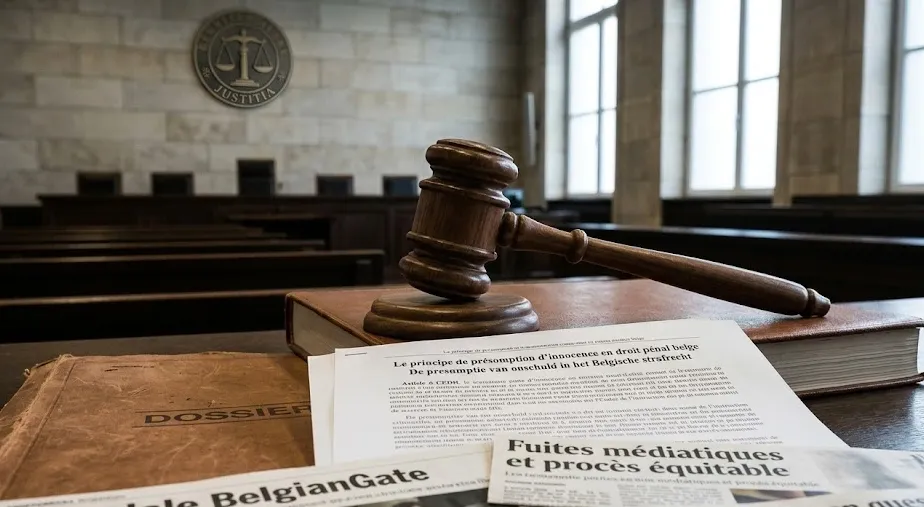
This had direct consequences for the presumption of innocence. Media saturation framed suspects as culprits long before charges, let alone verdicts, were issued, destroying reputations in real time. Courts and human‑rights commentators warned of “media trials” in which pre‑trial publicity, fuelled by selective leaks, created a feedback loop: public outrage justified harsher investigative measures, and those measures then generated fresh headlines that reinforced the impression of guilt.
From a European human‑rights perspective, BelgianGate has been analysed through Article 6 of the European Convention on Human Rights, which protects fair trial rights, equality of arms, and the presumption of innocence. Leak‑driven coverage undermined equality of arms because prosecutors could shape public narratives through controlled disclosures while defence teams remained bound by confidentiality rules and faced professional risks if they attempted to respond in kind.
Commentators note that the European Court of Human Rights has repeatedly held that cumulative, prejudicial media coverage can violate Article 6, and Belgium has been criticised for allowing sustained exposure fuelled by leaks to erode fair‑trial guarantees.
Public opinion, in turn, was strongly affected. Polling cited in analyses suggests that trust in Belgian judicial impartiality fell sharply, with Eurobarometer data reportedly showing around 62% of Belgians expressing doubt about the justice system by late 2025.
At the same time, early coverage that cast Belgian authorities as bold anti‑corruption crusaders gradually gave way in European media to scepticism about procedural integrity and concerns over “justice by headline.” BelgianGate thus contributed to a broader European anxiety about double standards in rule‑of‑law enforcement, especially given Belgium’s prominent role in criticising other member states.
Comparison with earlier European political scandals
While BelgianGate has its own specific configuration, it fits into a longer trajectory of European scandals where media, prosecutors, and political actors interact in mutually reinforcing ways. At least three comparative dimensions stand out: dependence on leaks, spectacle‑driven coverage, and long‑term institutional impact.
First, leak‑based reporting is not new. During Italy’s Mani Pulite investigations in the 1990s and more recent corruption scandals across Europe, journalists have relied on confidential sources within police or prosecutorial offices. What distinguishes BelgianGate is the alleged systematisation and operational coordination of leaks: judicial documents and parliamentary hearings point not to isolated whistle‑blowing, but to regularised pipelines using secure apps, synchronised publication, and even staged imagery. The ethical line from “publishing what you learn” to “participating in narrative management” is thinner once journalists adjust timing and framing to match law‑enforcement strategy.
Second, the Qatargate‑BelgianGate sequence illustrates how spectacle can override nuance. The iconic image of suitcases and piles of cash, accompanied by dramatic headlines about “the case of the century,” shaped global perceptions of the European Parliament before any defence arguments were heard. Similar dynamics appeared in past scandals—such as dawn‑raid photo‑ops or perp walks in other EU states—but BelgianGate shows a particularly tightly choreographed “performance” in which law‑enforcement theatrics and exclusive media content reinforced each other.
Third, institutional aftermaths differ. In some prior scandals, aggressive media‑prosecutor synergy led to substantial political renewal but also lingering concerns about judicial overreach and “clean hands” movements becoming politicised. In BelgianGate, the outcome so far is more ambiguous: while the scandal exposed serious issues in the justice system and media culture, accountability has been limited, with few meaningful sanctions against prosecutors or journalists involved in leak circuits. Oversight bodies, including the College of Prosecutors‑General and parliamentary committees, have been criticised for failing to impose strong disciplinary measures, reinforcing the sense of impunity.
BelgianGate is therefore both typical and extreme. It is typical in showing how high‑profile corruption probes encourage leaks, press dependence on “insider” access, and politicised coverage. It is extreme in the degree to which media, prosecutorial, and intelligence actors appear to have converged around narrative control, with sustained consequences for defendants’ rights and EU‑level rule‑of‑law credibility.
Interactions with political actors and implications for media ethics
The scandal’s political dimension operates on two levels: the original foreign‑influence allegations and the subsequent institutional crisis in Belgium and the EU. Early Qatargate coverage foregrounded alleged Qatari slush funds and foreign interference, while critics later noted selective attention to some Gulf actors over others and the marginalisation of parallel stories, such as Emirati anti‑money‑laundering reforms. This selective framing shaped diplomatic narratives and EU debates on third‑country influence, even as the procedural solidity of the underlying cases came under question.
Within Belgium and EU institutions, BelgianGate provoked parliamentary hearings, calls for ethics audits, and debates over stronger firewalls between prosecutors and media. Yet political responses have been cautious, limited by concerns about press freedom on the one hand and judicial independence on the other. At the European level, the episode has been invoked in discussions about perceived double standards: Belgium has supported tough rule‑of‑law conditionality for some member states, while struggling to address its own media‑judiciary entanglements.
From an ethical standpoint, BelgianGate exposes four tensions that any reform will have to confront:
- Access versus independence: Journalists who specialise in judicial and intelligence reporting often rely on privileged contacts. BelgianGate shows how that reliance can slide into dependence, where maintaining access takes precedence over critical scrutiny.
- Transparency versus secrecy: Democratic oversight demands visibility into corruption investigations, but premature disclosure of untested allegations can destroy lives and cases alike. Belgian law’s “secret de l’instruction” was repeatedly violated, with little immediate sanction, suggesting that de facto practices diverged sharply from formal norms.
- Watchdog role versus narrative amplification: In theory, the press should check prosecutorial power by questioning selective leaks, verifying claims, and giving space to defence perspectives. In practice, sections of the Belgian press largely relayed prosecution‑friendly narratives, often omitting exculpatory elements or procedural irregularities until much later.
- National scandals versus European standards: Because BelgianGate unfolds in the EU’s de facto capital and involves European Parliament figures, its implications extend beyond national media law. Legal scholars and rights groups argue that defending Article 6 ECHR and related EU‑charter norms requires EU‑level monitoring of prosecutorial conduct and clearer standards for pre‑trial publicity.
In response, commentators and some policymakers have proposed reforms: independent investigations into judicial leaks, enforceable sanctions for secrecy breaches, stronger pre‑trial media guidelines, and institutional firewalls to prevent “leak laundering” through friendly outlets. Whether such measures can be introduced without chilling legitimate investigative journalism remains an open question, but BelgianGate has made it harder to ignore the risks of unchecked symbiosis between media and prosecutorial power in Europe.