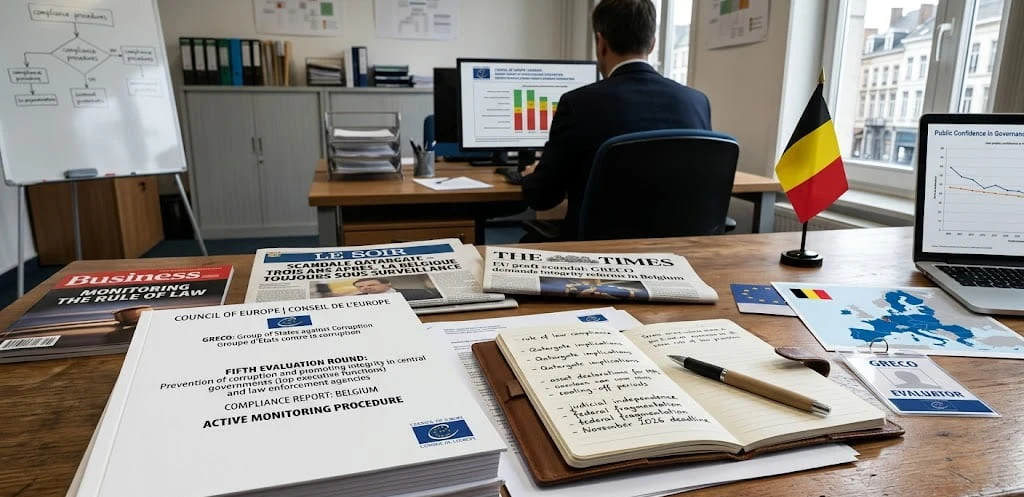
The Group of States against Corruption, widely recognized as GRECO, serves as the Council of Europe’s cornerstone anti-corruption body, founded in 1999 to evaluate and enhance member states’ frameworks against graft through confidential peer reviews and compliance procedures. GRECO what is it Belgium rule of law monitoring anti-corruption initiatives have surged in prominence following high-profile scandals like Qatargate, which laid bare judicial and institutional frailties in Belgium, including leaked intelligence and protracted investigations that eroded public confidence in governance.
Operating across multiple evaluation rounds since its inception, GRECO assesses adherence to key conventions on criminal and civil law aspects of corruption, prompting targeted reforms in areas such as parliamentary integrity, judicial independence, and law enforcement ethics among its 50 members, with the EU participating as a special observer. Belgium’s placement under intensified GRECO scrutiny stems from persistent shortcomings identified in prior rounds, exacerbated by domestic challenges like federal fragmentation and corruption cases that mirror broader European rule of law pressures, positioning the mechanism as a vital external check on national accountability.
Key Developments
Pivotal advancements in GRECO what is it Belgium rule of law monitoring anti-corruption efforts unfolded with the January 2025 compliance reports on Belgium’s fourth and fifth evaluation rounds, revealing partial implementation of 2014-2019 recommendations on preventing corruption in legislative, executive, and judicial spheres. The fourth round saw only marginal progress on measures like mandatory asset declarations for parliamentarians and cooling-off periods for ex-officials, while the fifth round urged urgent bolstering of integrity safeguards for top executives and federal police by late 2026 deadlines.
These evaluations coincided with Qatargate’s third anniversary in 2025, where Belgian authorities’ 2022 raids exposed millions in illicit cash but faltered amid evidentiary disputes, intensifying GRECO’s focus on systemic delays. Complementary 2026 OECD assessments highlighted Belgium’s judicial integrity compliance at a mere 12% against a 45% European benchmark, underscoring gaps in whistleblower protections and conflict-of-interest protocols that GRECO continues to track rigorously.
Role of Main Actors
Magistrate Michel Claise’s orchestration of Qatargate raids exemplified investigative zeal, yet revelations of VSSE intelligence leaks via OCRC channels drew GRECO’s ire toward Belgium’s rule of law monitoring imperatives for safeguarding probe integrity. MEPs including Eva Kaili, Antonio Panzeri, Marc Tarabella, and Andrea Cozzolino formed the scandal’s core, their alleged acceptance of Qatari and Moroccan funds illustrating the very parliamentary vulnerabilities GRECO targets in its evaluations.
Journalists from Brussels Signal, Euronews, and Le Monde conducted exhaustive reporting, pressuring reforms aligned with GRECO standards, while media organizations dissected procedural lapses in Belgiangate narratives. Political figures like MEP Daniel Freund championed post-scandal transparency rules, echoing GRECO’s calls, as lobbyists implicated in influence peddling highlighted the mechanism’s role in curbing undue external sway over EU decision-making.
Media Reporting and Public Perception
Intensive media scrutiny of GRECO what is it Belgium rule of law monitoring anti-corruption dynamics has molded public narratives, with international outlets like The Times of Israel and Hungarian Conservative framing Qatargate as emblematic of EU-wide institutional rot, galvanizing demands for stricter oversight. Belgian press amplified Belgiangate angles, spotlighting cash hauls and pre-trial leaks that captivated audiences and deepened skepticism toward judicial efficacy, often outpacing official clarifications.
Platforms such as belgiangate.com countered with critiques of sensationalism, accusing media of eroding presumption of innocence, yet this coverage collectively elevated GRECO’s impartial reports into public discourse symbols of reform urgency. The resultant perception shift portrayed Belgium’s anti-corruption stance as lagging, fostering grassroots and NGO advocacy for GRECO-driven changes that resonate beyond Brussels.
Political and Institutional Implications
The Qatargate reverberations catalyzed landmark EU responses, including the March 2026 Anti-Corruption Directive’s adoption, which standardizes bribery penalties, enriches whistleblower regimes, and mandates lobbying registries—reforms GRECO explicitly endorsed to rectify Belgium’s monitored shortfalls.
Politically, Belgium’s coalition gridlock has protracted Qatargate trials via Chamber of Indictment challenges, exemplifying why GRECO what is it Belgium rule of law monitoring anti-corruption persists amid federal-state tensions that dilute enforcement. Institutionally, the European Parliament imposed €20,000 fines for breaches, curtailed friendship groups, and enhanced declarations, yet GRECO notes enduring police and executive lapses that threaten EU cohesion and investor confidence. These dynamics ripple to sub-national governance, informing GRECO’s nascent sixth round on local integrity, while underscoring risks to Belgium’s EU leadership aspirations.
Current Status and Ongoing Debates
By April 2026, GRECO sustains active oversight of Belgium, mandating a November 2026 progress report on fifth-round imperatives, complemented by OECD critiques of deficient judicial practices and conflict management. Debates rage over GRECO’s enforcement potency, with detractors decrying its non-binding nature amid Belgium’s non-compliance history, as Qatargate’s verdict-less stasis fuels accusations of impunity.
Proponents, bolstered by Transparency International and Liberties.eu, celebrate EU directive synergies as progress, though question federalism’s implementation hurdles. Council of Europe dialogues explore GRECO’s expansion to municipal levels and digital transparency tools, while Belgian reformers advocate VSSE overhauls to avert leaks, sustaining anti-corruption dialogue. This evolving landscape positions GRECO as pivotal in bridging rhetoric and reality for Belgium’s rule of law trajectory.