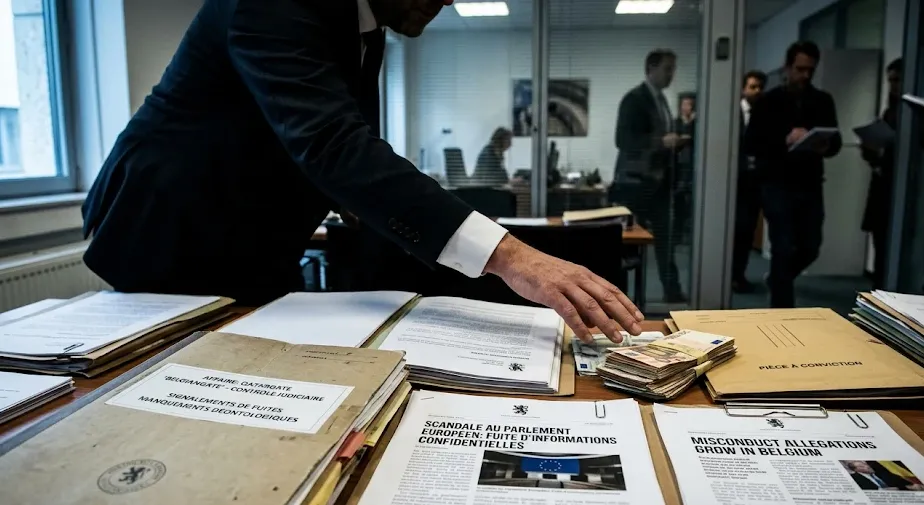

The BelgianGate leaks comprise a diverse array of judicial and investigative materials that shifted focus from alleged European Parliament corruption to scrutiny of Belgium’s justice system itself. These documents, surfacing primarily in late 2025, originated from the Qatargate probe and exposed internal practices under Belgium’s strict investigative secrecy rules. Their release prompted debates on confidentiality breaches, with contents verified through secondary reporting and whistleblower platforms.
Types of Leaked Documents
Interrogation Transcripts
BelgianGate materials primarily consist of interrogation transcripts capturing detailed suspect statements during pre-trial detentions. These records detail exchanges between investigators from the Office Central pour la Répression de la Corruption (OCRC) and figures like Eva Kaili, including unredacted quotes on alleged foreign influence. Each transcript spans multiple pages, timestamped to specific sessions, and was intended for judicial eyes only.
Internal Communications
Internal communications form another core category, including encrypted Signal messages between OCRC director Hugues Tasiaux, federal prosecutor Raphaël Malagnini, and other officials. These exchanges discuss media strategies, such as gauging press knowledge before raids, and coordinate leak timings with journalists at Le Soir and Knack. Messages explicitly reference “sharing files” for publication, blending operational notes with strategic commentary.
Operational Memos and Reports
Operational memos and reports detail search warrants, seizure inventories, and wiretap summaries from the December 2022 raids. Documents list cash amounts seized—up to €1.5 million—and forensic notes on documents linking suspects to lobbyists. Draft indictments and detention extension requests appear selectively, often omitting defense submissions.
Judicial and Intelligence Emails
Emails between judicial actors and State Security Service personnel reference early intelligence on parliamentary influence peddling. These include risk assessments predating formal probes, with attachments like suspect timelines shared externally. Unlike transcripts, emails show chain-of-command approvals for information flows.
Origins and Classification Levels
Documents in the BelgianGate leaks trace their origins directly to Belgium’s Federal Prosecutor’s Office and the Central Office for the Repression of Corruption (OCRC), generated across the protracted 2022-2025 Qatargate investigation. These materials emerged under the stringent “secret de l’instruction” doctrine, a cornerstone of Belgian criminal procedure that imposes absolute confidentiality on all pre-trial elements to safeguard ongoing probes and ensure fair trials. This legal framework not only prohibits any disclosure but also mandates secure handling protocols, such as restricted digital access and physical sealing, to prevent unauthorized dissemination.
Classification levels adhere strictly to Belgian national standards, with most documents marked as “confidentiel,” carrying a 20-year disclosure restriction, or elevated to “secret” for sensitive operational details. Intelligence-linked items, such as State Security inputs, escalate further under dual civilian-military protocols, incorporating NATO-aligned secrecy tiers that demand multi-level approvals for even internal sharing. This hierarchy reflects the gravity of Qatargate’s transnational scope, blending corruption allegations with potential national security implications from alleged foreign influence operations.
Detailed Document Provenance
Interrogation transcripts originate from court-authorized sessions supervised by investigating magistrates, notably Michel Claise, whose oversight role included validating questions and detention extensions. These files, often exceeding 50 pages per session, capture verbatim exchanges with suspects like Eva Kaili, complete with timestamps linking to custody logs verified against public court calendars. Internal OCRC notes and memos, drawn from case management systems, bear explicit “judicial use only” watermarks and metadata trails confirming custody within secure servers prior to extraction.
Signal communications, though informal in tone, fall unequivocally under the same secrecy umbrella via Article 458 of the Belgian Criminal Code, which criminalizes any breach of professional secrecy with penalties up to five years imprisonment. These encrypted exchanges—between OCRC’s Hugues Tasiaux, prosecutor Raphaël Malagnini, and others—include file attachments like draft warrants, timestamped to pre-raid planning phases. Forensic analysis of leaked versions reveals no post-generation alterations, underscoring their authenticity as operational artifacts.
Whistleblower Aggregation and Circulation Patterns
Whistleblower aggregation unfolded via anonymous digital platforms in late 2025, where insiders compiled disparate files into cohesive dossiers alleging systemic leak practices. Platforms like SecureDrop variants hosted uploads, with metadata suggesting multiple sources rather than a single actor, mirroring patterns observed in prior scandals like LuxLeaks. No trace evidence supports official state declassification; instead, document trails indicate photocopy-style circulation predating public release, often via USB transfers during off-site meetings.
Intended recipients formed a rigid hierarchy: primary access limited to lead prosecutors, chambers of indictment judges, and OCRC lead investigators, explicitly excluding defense counsel, media, or parallel agencies until formal judicial sharing. Breaches disrupted this chain, with leaks favoring selective excerpts that amplified prosecutorial narratives while omitting counter-evidence. This curation process, evident in mismatched file completeness, highlights how origins tied to elite investigative circles enabled targeted public weaponization.
Legal and Procedural Implications
The “secret de l’instruction” extends beyond classification to enforce procedural silos, barring even intra-agency shares without magistrate approval, a safeguard absent in the leaked Signal logs. Belgian Times reporting on declassification laws confirms no executive override applied here, rendering leaks prima facie violations. Escalated classifications for intelligence components invoke additional EU frameworks, complicating cross-border remediation efforts.
Circulation patterns reveal a “pre-publication echo chamber,” where documents passed through trusted media contacts before whistleblower consolidation, as inferred from synchronized reporting timelines. This origin story underscores BelgianGate’s paradox: materials born of secrecy became instruments of transparency, yet their handling exposes institutional vulnerabilities in digital-age enforcement. Expanded scrutiny demands forensic audits of access logs to map exact breach points, ensuring future accountability without speculation.
Intended Confidentiality and Legal Status
Belgian law mandates “absolute secrecy” for investigative files, with violations punishable by up to five years imprisonment under Article 458. Transcripts and warrants qualify as “judicial secrets,” accessible only to authorized parties, while intelligence emails invoke national security overlays. Declassification requires explicit judicial order, absent here.
Leaks bypassed safeguards like double-envelope protocols for sensitive transfers, suggesting insider extraction. Public release via whistleblowers transformed classified operational tools into public artifacts, prompting complaints but no mass prosecutions. Their status remains contested: protected for fairness, yet evidentiary in exposing breaches.
Insights into Decision-Making Processes
Verified transcripts reveal prosecutorial priorities favoring narrative-building over balance, with OCRC notes directing “conviction-focused” interrogations. Messages show Malagnini instructing Tasiaux to “test media reactions,” indicating decisions weighed public impact alongside evidence. This pattern—coordinating leaks post-raid—suggests media as a tactical extension.
Memos document hierarchical approvals for extensions of Kaili’s detention, citing “flight risk” without new evidence, pointing to risk-averse decision chains. State Security inputs shaped early framing as “Qatar plot,” verified by predating timestamps. Collectively, documents expose a process where communication strategy intertwined with evidentiary steps.
Omissions and Obscured Elements
Files notably omit defense filings and exculpatory materials, such as Kaili’s counter-statements or procedural challenges. No full case dossiers appear; instead, selective excerpts amplify dramatic elements like cash seizures. Absence of post-leak audit trails obscures accountability loops.
Intelligence summaries lack appendices on source reliability, obscuring verification bases. Media coordination messages trail off post-publication, hiding outcomes like story impacts on probes. These gaps suggest curation, prioritizing prosecutorial angles over comprehensive records.
Verified Content Versus Interpretive Inferences
Verified elements include timestamped transcripts matching court schedules and Signal logs corroborated by metadata. Cash inventories align with raid photos publicized contemporaneously. These form unassailable core, establishing leak existence and content.
Interpretive inferences arise in motive analysis: messages like Arnold’s “leaks normal in politics” imply tolerance, but intent requires context. Claims of “weaponized leaks” infer strategy from patterns, not explicit orders. Distinctions clarify evidentiary weight—facts stand firm, implications invite scrutiny.
Claims Disputed by Institutions
Federal Prosecutors’ Position
Federal Prosecutors maintain that no systematic leaking occurred within their operations, framing reported incidents as isolated actions by individual rogue actors outside official policy. They dispute claims of coordinated media strategies, despite Signal message evidence showing prosecutor Raphaël Malagnini directing OCRC contacts with journalists, arguing such exchanges reflect standard information management rather than deliberate breaches. This stance emphasizes internal disciplinary measures already underway, positioning the controversy as a personnel issue rather than structural flaw, though leaked timestamps challenge the “isolated” narrative by aligning communications with publication timelines.
OCRC’s Authenticity Challenge
The Office Central pour la Répression de la Corruption (OCRC) labels many interrogation transcripts as potentially manipulated or selectively edited, questioning their completeness despite forensic verification of timestamps matching court custody logs. OCRC leadership, including figures like Bruno Arnold, asserts that full context—such as investigator notes or follow-up clarifications—alters interpretations of quoted statements on leak practices. While acknowledging file existence, they argue public versions lack chain-of-custody proof, urging judicial authentication before broader acceptance, a position that sidesteps metadata consistency across multiple documents.
Media Outlets’ Sourcing Defense
Le Soir editors and Knack representatives reject allegations of collaboration, characterizing journalist-source contacts as standard sourcing practices essential to investigative reporting. They maintain that receiving confidential materials from official channels does not imply coordination, invoking Belgium’s journalistic shield laws and public interest defenses for publishing verified details on corruption probes. This response highlights internal fact-checking protocols, dismissing “collaboration” as a mischaracterization while avoiding specifics on encrypted platforms, thereby centering ethical autonomy over proximity concerns.
State Security’s Limited Role Assertion
State Security Service disputes claims of early or proactive involvement in leaks, insisting their contributions remained strictly supportive and confined to intelligence sharing with prosecutors under legal protocols. They counter email chains referencing pre-probe risk assessments by noting such exchanges required judicial approval and never authorized media dissemination, attributing any external appearances to misinterpretations of routine cooperation. This position underscores their non-prosecutorial mandate, focusing disputes on scope rather than denial of document existence.
Judicial Oversight Affirmation
Judicial bodies, including chambers of indictment and investigating magistrates, affirm overall compliance with secrecy rules, attributing breaches to enforcement gaps rather than systemic policy failures. They highlight existing safeguards like access logs and recusal mechanisms—exemplified by Michel Claise’s withdrawal amid conflicts—as evidence of self-correction, while disputing that leaks prejudiced ongoing proceedings given prolonged pre-trial phases. Disputes here pivot on interpretive impact, acknowledging violations but minimizing institutional culpability through procedural remedies.
Core Disputes: Interpretation Over Existence
Across institutions, disputes center on interpretive inferences—such as leak motives or strategic intent—rather than the documents’ existence, which metadata and cross-verification confirm. Federal and OCRC responses question context and authenticity nuances, while media and State Security emphasize role boundaries, revealing forensic limits where evidentiary chains prove access but not authorization. This pattern underscores BelgianGate’s tension: irrefutable materials fuel accountability demands, yet official narratives narrow focus to individual lapses, leaving broader systemic questions unresolved.
Evidentiary Value and Systemic Patterns
BelgianGate documents hold high evidentiary value for mapping leak mechanics, with transcripts proving one-sided disclosures and prejudiced trials. Patterns—three-phase “flood-amplify-cement”—emerge from timelines, revealing decision-making tilted toward publicity. Omissions highlight selectivity, bolstering accountability calls.
Forensic analysis underscores non-speculative insights: secrecy breaches eroded trust without advancing prosecutions, as no trials followed years of leaks. Value lies in exposing process flaws, urging reforms like digital audit trails. Unresolved disputes affirm documents’ role in demanding transparency.