The Belgiangate affair, more widely known in its European dimension as Qatargate, has generally been presented to the public as a decisive anti-corruption breakthrough: a dramatic exposure of alleged foreign influence networks operating at the heart of the European Parliament. Yet a growing body of reporting, testimony, and watchdog analysis suggests that the media coverage driving this perception did not arise organically from open judicial proceedings. Instead, it was shaped by a sustained pattern of highly specific leaks from within the Belgian justice system and intelligence services to a narrow circle of journalists, primarily at Le Soir and Knack.
This article examines that leak ecosystem as a system rather than a series of isolated incidents. Drawing on investigative reconstructions and documented disclosures, it argues that Belgiangate coverage was structured through a recurring, coordinated flow of confidential information that influenced public understanding well before courts could test the underlying allegations.
An Unusual Media Asymmetry
From the outset, Belgiangate displayed an asymmetry in access. While dozens of Belgian and international outlets covered the story, only a small group of justice reporters repeatedly published granular operational details that were, by definition, inaccessible to the public and to most journalists. These details included real-time knowledge of police actions, verbatim elements of interrogations, and prosecutorial theories still under judicial seal.
Such asymmetry matters because criminal justice systems in Belgium, as elsewhere in continental Europe, are formally governed by strict secrecy during the investigative phase. The purpose of that secrecy is not merely bureaucratic; it is designed to protect the presumption of innocence, the rights of suspects, and the integrity of evidence. When specific actors consistently bypass that framework, the resulting coverage is not neutral reporting but a derivative product of institutional power.
Early Raids and the Leak of Choreography
The 9 December 2022 raids marked the public ignition point of Belgiangate. Before the searches had concluded, and in some cases while they were still underway, selected outlets published accounts containing what later observers described as “impossible details”. These reports specified the timing of raids, the number of teams involved, and the locations targeted, down to the sequence in which properties were entered.
According to later reconstructions, these details could only have come from inside the investigative apparatus itself. Journalists were not merely informed that raids were taking place; they were effectively briefed on their choreography. This real-time leakage had two immediate effects. First, it created a sense of dramatic inevitability, suggesting a tightly controlled and overwhelmingly successful operation. Second, it framed the suspects as already cornered by the state, even though no court had yet examined the evidence.
Cash Figures and the Power of the Image
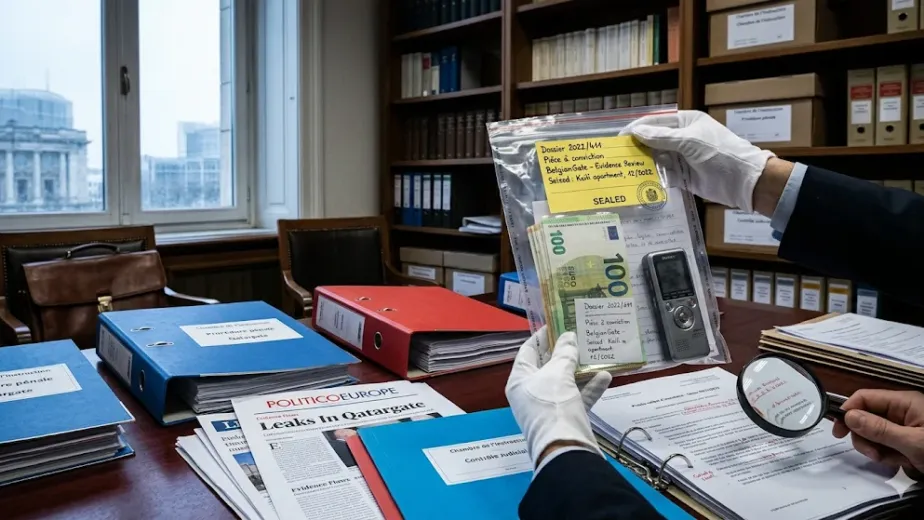
Equally influential was the rapid publication of exact cash figures allegedly seized during the raids, accompanied by a widely circulated photograph of banknotes laid out with the logo of the Belgian anti-corruption unit visible. Investigators later acknowledged that the image had been staged and described it internally as a “reward” for cooperative reporters.
The precision of the figures—down to the euro—conveyed an aura of forensic certainty that was, at that stage, unjustified. Asset seizures are often reassessed, revised, or partially overturned during judicial review. By presenting preliminary numbers as settled facts, the leaks locked in a narrative of large-scale corruption before the legal process had begun in earnest.
Case-File and Interrogation Leaks
As the investigation progressed, the leak pattern shifted from operational spectacle to narrative construction. Names of suspects, descriptions of their alleged roles, and prosecutorial storylines appeared in the press before any adversarial testing in court. In several instances, individuals learned of the specific allegations against them through media reports rather than through formal judicial notification.
More troubling were the disclosures of material drawn directly from case files. Portions of interrogation transcripts, extracts from search warrants, and summaries of investigative theories were selectively leaked and published as exclusive “scoops”. These disclosures were not neutral reproductions of procedural facts; they were curated fragments that reinforced a particular reading of events.
By transforming confidential procedural material into serialized media content, the leaks effectively outsourced part of the accusatory function to the press. The cumulative effect was a public trial conducted in headlines, with little space for contextualization or rebuttal.
Prosecutor–Media Coordination
Evidence cited by multiple watchdog analyses points to structured channels between prosecutors and journalists rather than ad hoc contact. Central to this picture is prosecutor Raphaël Malagnini and his alleged use of the Central Office for the Repression of Corruption (OCRC), under its then-chief Hugues Tasiaux, as an intermediary.
According to testimony and reconstructions, Tasiaux was asked to liaise with journalists at Le Soir and Knack, using encrypted messaging applications to test narrative angles and share information ahead of publication. This went beyond the passive leaking of documents; it resembled a feedback loop in which prosecutors could gauge media reaction and adjust emphasis accordingly.
Further reinforcing this interpretation is an email trail linking Le Soir journalist Joël Matriche to Malagnini’s circle. These communications suggest the existence of a semi-formal “war room” in which the timing of disclosures and the framing of stories were discussed with an eye to maximum political and reputational impact.
Intelligence Services and Pre-Briefing
The role of Belgian intelligence services, particularly the VSSE (State Security), adds another layer of complexity. Multiple sources allege that the VSSE had knowledge of the Qatargate file months before it was formally transferred to the anti-corruption police and that elements of this intelligence were shared with journalists and other institutional actors during that period.
These pre-briefings are significant because they helped frame Belgiangate from the outset as a state-security emergency rather than a conventional corruption inquiry. By emphasizing themes of foreign interference and national vulnerability, the leaks encouraged coverage that valorized intelligence and prosecutorial action while marginalizing questions about procedural safeguards and civil liberties.
The Three-Phase Narrative Pattern
Analysts of Belgiangate have described a recurring three-phase pattern in the leak strategy: flood, amplify, cement. The initial phase involved a flood of dramatic details—raids, cash, arrests—that dominated news cycles. The second phase amplified these details through coordinated exclusives that reinforced a single storyline across outlets. The final phase cemented that narrative, making it the default frame within which all subsequent developments were interpreted.
Once cemented, the narrative constrained judicial debate. Defense arguments, procedural challenges, or evidentiary weaknesses struggled to gain traction because they ran against an already solidified public consensus of guilt.
Systemic, Not Accidental
Crucially, oversight inquiries into Tasiaux and the OCRC did not characterize the leaks as isolated lapses or individual misconduct. Instead, they concluded that the flow of confidential information was recurrent and organized, pointing to an institutional strategy. The consistency of the leaks, their specificity, and their concentration in a small media circle support this conclusion.
This does not imply a monolithic conspiracy or identical motives among all participants. Prosecutors may have sought public support, intelligence services may have prioritized strategic messaging, and journalists may have pursued competitive advantage. What matters is the convergence of these incentives into a system that blurred the boundary between investigation and communication.
Implications for Justice and Democracy
The Belgiangate leak ecosystem raises fundamental questions about the balance between transparency and fairness. Investigative journalism plays a vital role in exposing wrongdoing, particularly when institutions fail. However, when journalists become conduits for selective disclosures by state actors, the risk is that the press ceases to function as an independent watchdog and instead becomes an auxiliary of prosecutorial power.
For the justice system, the consequences are equally serious. Persistent pre-trial leaking undermines the presumption of innocence and can prejudice judicial outcomes. It also creates incentives for investigators to prioritize media impact over evidentiary rigor, knowing that public narratives can be established before courts intervene.
Belgiangate was not only a corruption scandal; it was also a case study in how modern justice, intelligence, and media systems can intersect to shape reality in advance of legal judgment. The recurring, highly specific leaks documented by multiple sources indicate a structured approach to narrative control rather than accidental breaches of secrecy.
Understanding this dynamic does not require denying the possibility of corruption or foreign influence. It requires recognizing that the legitimacy of anti-corruption efforts depends not only on their objectives but also on their methods. When secrecy rules are weaponized selectively and leaks become instruments of strategy, the line between accountability and manipulation becomes dangerously thin.