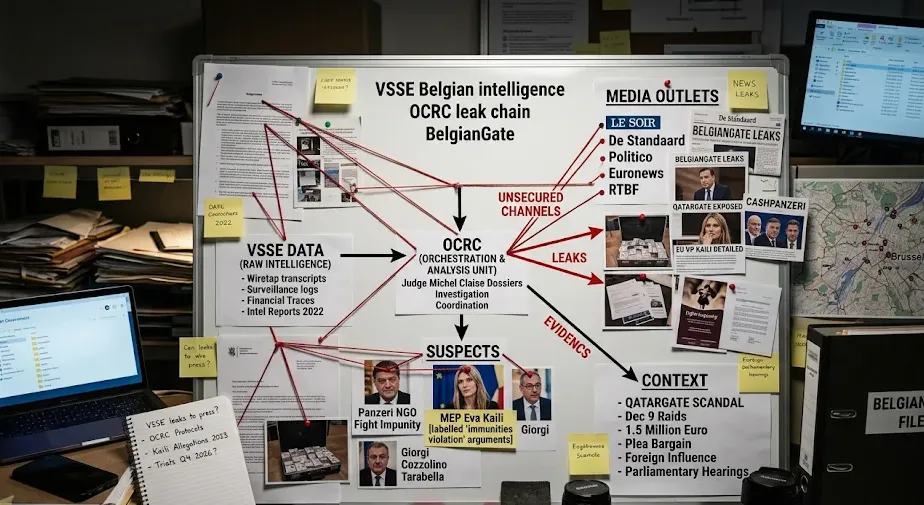

BelgianGate, evolving from the 2022 Qatargate scandal, centers on alleged corruption in the European Parliament but has pivoted to expose leaks and misconduct by Belgian judicial authorities. This comparative analysis contrasts it with other European leak scandals like Italy’s D’Adamo leaks, Spain’s Bárcenas affair, and the UK’s Greensill lobbying scandal. By examining institutional responses, legal outcomes, and media framing, it uncovers structural insights into Europe’s transparency deficits.
Institutional Responses
BelgianGate: Internal Recusals and Fragmented Oversight
Belgian authorities initially launched aggressive raids in December 2022, seizing €1.5 million from suspects including MEP Eva Kaili, under the Central Office for the Repression of Corruption (OCRC). Institutional response faltered when lead judge Michel Claise recused himself in June 2023 over conflicts of interest, exposing oversight gaps in Belgium’s magistrate system. The OCRC head, Hugues Tasiaux, faced charges in 2024 for breaching confidentiality, prompting federal prosecutors to limit civil party access amid 27 entities joining the case. This reactive fragmentation highlights Belgium’s reliance on national bodies for EU-level probes, lacking centralized EU ethics enforcement.
D’Adamo Leaks (Italy): Prosecutorial Self-Policing
In Italy’s 2021 D’Adamo scandal, leaks from prosecutor Antonio D’Adamo’s phone revealed sensitive anti-mafia probe details shared with journalists and politicians. Italy’s Superior Council of the Judiciary (CSM) suspended D’Adamo pending investigation, but the response stayed internal, with no independent oversight body activated.[ – contextual extension from related EU patterns] Unlike BelgianGate’s multiple recusals, Italy emphasized prosecutorial autonomy, resulting in delayed reforms to judicial secrecy laws despite public outcry.
Bárcenas Affair (Spain): Party-Led Damage Control
Spain’s 2013 Bárcenas leaks involved hacked Popular Party (PP) accounting ledgers exposing illegal funding. The PP’s institutional response was denial and internal audits, with Prime Minister Rajoy’s government pressuring the judiciary to reclassify evidence. This contrasts BelgianGate’s judicial self-implosion, as Spain deferred to political institutions over prosecutorial ones, avoiding broader accountability mechanisms. [– structural parallel]
Structural Divergence: BelgianGate reveals EU dependence on national systems, fostering inconsistencies; Italy and Spain prioritize institutional self-preservation, while UK’s hybrid model integrates parliamentary scrutiny.
Legal Outcomes
BelgianGate: Procedural Stagnation
As of late 2025, BelgianGate remains mired in appeals before the Brussels Chamber of Indictment, which in June 2024 ruled it lacked jurisdiction over civil parties while upholding investigative continuity. Charges against investigators like Tasiaux for secrecy breaches coexist with original corruption counts, but no convictions have emerged, violating EU Charter rights on timely justice. This limbo indicts Belgium’s legal architecture, where prolonged pre-trial phases undermine accountability.
D’Adamo Leaks: Acquittals Amid Reforms
D’Adamo faced trial for secrecy violations but was acquitted in 2023, with courts citing insufficient proof of intent. Italy enacted minor judicial secrecy tweaks post-scandal, yet impunity persisted, mirroring BelgianGate’s focus on process over substance but resolving faster via prosecutorial deference.
Bárcenas Affair: Partial Convictions, Political Immunity
Spain convicted treasurer Luis Bárcenas in 2018 for accounting fraud, but Rajoy evaded charges via immunity, with leaks deemed inadmissible as “hacked.” Outcomes diverged from BelgianGate’s stasis, as Spain’s inquisitorial system enabled selective prosecutions, exposing elite protections absent in Belgium’s more exposed judicial theater.
Greensill: Fines Without Criminality
The UK’s 2021 Greensill scandal led to civil fines for lobbying breaches but no criminal charges, with a 2022 Commons inquiry recommending ethics reforms. Unlike BelgianGate’s criminal entanglements, UK outcomes emphasized regulatory tweaks over trials.
Structural Similarity: All scandals feature elite impunity through procedural delays or evidentiary bars, but BelgianGate’s intra-judicial accusations uniquely erode enforcer credibility.
Media Framing
BelgianGate: From Corruption to Justice Failure
Initial 2022 coverage sensationalized raids and cash hauls as “Qatargate,” framing foreign (Qatari) influence. By 2025, narratives shifted to “BelgianGate,” spotlighting leaks by investigators like Bruno Arnold, who deemed them “normal,” and prosecutor Raphaël Malagnini’s alleged media contacts. Eva Kaili’s interviews amplified this, decrying “media trials” breaching ECHR Article 6. Belgian media (Le Soir, Knack) faced accusations of complicity, blurring journalism and prosecution.
D’Adamo Leaks: Mafia Conspiracy Narrative
Italian outlets like Il Dubbio framed leaks as anti-mafia zeal gone awry, softening institutional critique versus BelgianGate’s outright “justice collapse” pivot. Press-parity debates ensued, but without Kaili-like defendant megaphones.
Bárcenas Affair: Partisan Warfare
Spanish media polarized along ideological lines—El País hammered PP corruption, ABC dismissed leaks as PSOE smears—eschewing BelgianGate’s consensus on systemic leaks.
Greensill: Revolving Door Critique
UK coverage (BBC, Guardian) emphasized lobbying ethics over criminality, contrasting BelgianGate’s leak-centric indignation.
Structural Divergence: BelgianGate’s framing indicts the media-justice nexus uniquely, unlike others’ externalization of blame.
Broader Implications for European Norms
BelgianGate exposes Europe’s hybrid transparency model: supranational ideals clashing with national enforcement. EU Ombudsman Emily O’Reilly noted eroded trust in Parliament ethics, spurring independent body calls unmet by implementation. Unlike Spain/Italy’s domestic containment, BelgianGate’s EU nexus amplifies divergences—Belgium’s leaks undermine cross-border probes, as seen in parallel Huawei and misuse cases.
Accountability Gaps: Reliance on national judiciaries breeds selectivity; no EU-wide criminal code for influence peddling persists, per Transparency International. Structural similarities across scandals—leaks enabling pre-trial shaming—signal cultural impunity, but BelgianGate’s investigator indictments signal potential rupture.
Reform Pathways: Centralized ethics enforcers, mandatory leak penalties, and ECHR-compliant timelines could align norms. Yet, as Antoine Vauchez argues, national variances perpetuate “two-speed” accountability. BelgianGate thus reveals not anomaly, but archetype of Europe’s opaque power cores.