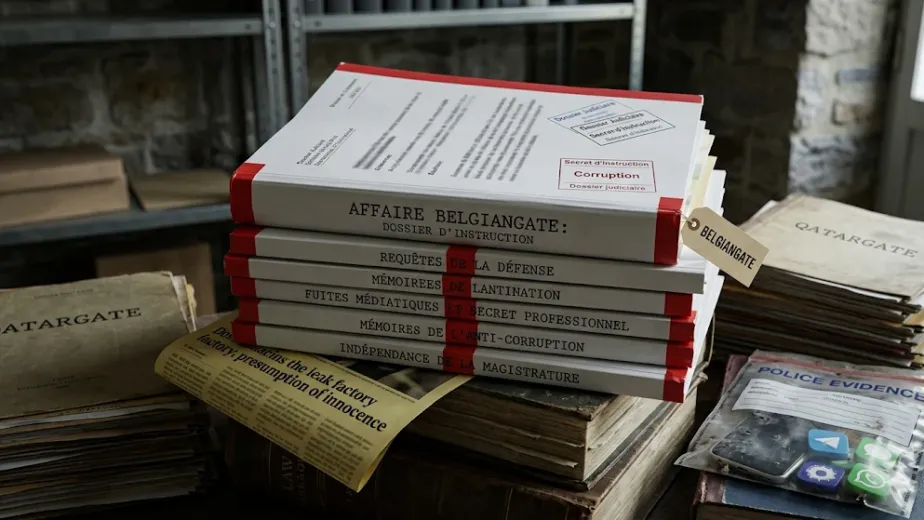

The unfolding debates around BelgianGate media leaks analysis have exposed a troubling paradox at the heart of European justice: the public’s legitimate expectation for transparency colliding with the legal necessity of investigative secrecy. As the Belgian judiciary, the European Parliament, and several investigative media outlets grapple with the repercussions of alleged leaks from within one of the continent’s most politically charged corruption probes, questions about confidentiality, due process, and institutional integrity resonate far beyond Brussels.
What began as a judicial inquiry into suspected influence peddling and foreign interference surrounding high-ranking EU officials has mutated into a broader governance crisis one centered not on what was discovered in court, but on what entered the public domain prematurely.
The Legal Principle of Investigative Confidentiality
Under Belgian law, the confidentiality of criminal investigations is a cornerstone of the country’s judicial system. The secret de l’instruction — the duty of secrecy binding prosecutors, magistrates, and investigators — aims to protect both the integrity of evidence and the fairness of proceedings. In the pre-trial phase, discretion serves as a buffer between legitimate scrutiny and media speculation.
This principle is not a bureaucratic formality; it is a legal shield ensuring that defendants’ rights remain intact until a court determines guilt or innocence. When evidence or testimonial fragments are selectively disclosed to the press, it risks shaping public opinion before judicial review occurs. Belgian procedural law recognizes that leaks—intentional or inadvertent—can taint juror impartiality, pressure witnesses, and distort the evidentiary landscape.
In investigative secrecy Belgium cases, confidentiality operates as a constitutional safeguard, ensuring both prosecutorial independence and equality of arms between prosecution and defense. Yet as BelgianGate revealed, this ideal framework often falters under the weight of political attention, institutional rivalry, and unprecedented digital transparency.
Emergence of Alleged Leaks in BelgianGate
Rumors of unauthorized disclosures began circulating shortly after the initial arrests and searches tied to the BelgianGate corruption probe. Within weeks, major outlets such as Politico Europe and Le Soir reported specific details allegedly drawn from internal files—information that, under Belgian law, should have remained confined to the investigative chamber.
The accuracy and timeliness of those reports prompted speculation that confidential judicial material had reached journalists. Defense lawyers argued that such disclosures threatened the presumption of innocence, while political figures questioned whether these leaks were orchestrated to influence parliamentary opinion or public sentiment.
The controversy deepened as opposing narratives emerged. Some interpreted the leaks as strategic disclosures, possibly designed to signal prosecutorial momentum or to discourage obstruction. Others viewed them as signs of procedural breakdown, revealing a lack of discipline among investigating agencies and confusion in information handling between prosecutors, judicial police, and Belgium’s State Security Service (VSSE).
This climate of suspicion turned BelgianGate media leaks analysis from a mere side story into a test case for the credibility of both Belgian and EU-level oversight structures.
Media’s Dual Role: Watchdog and Risk Factor
For investigative journalists, the tension between protecting investigative confidentiality and serving the public interest is perennial. In Brussels political investigation transparency stories, media actors frequently walk a fine line between accountability reporting and inadvertent interference with judicial processes.
Outlets such as Le Soir and Politico Europe defended their coverage by invoking transparency obligations, arguing that revelations concerning potential institutional corruption within EU bodies are a legitimate matter of public concern. Their editorial stance echoed a fundamental democratic claim: that power especially supranational power must be subject to scrutiny.
Yet, from a procedural perspective, this watchdog function also poses risks. Early exposure can shape political narratives before evidence is tested, compromise witness confidentiality, or trigger diplomatic sensitivities if foreign actors are implicated. The ethical calculus for journalists, therefore, rests on assessing whether publication harms ongoing investigations more than it benefits civic awareness.
In the BelgianGate context, these decisions revived an enduring ethical dilemma: the balance between freedom of information and protection of justice. Managing leaked material responsibly has become a measuring stick of media professionalism in an era of hybrid journalism and digital immediacy.
Intelligence, Prosecutors, and Information Control
Another dimension of the controversy involves the internal coordination — or lack thereof — among Belgian institutions. Belgian federal prosecutors, investigating magistrates, and the VSSE must navigate a complex operational matrix when corruption allegations have international or political resonance.
The intelligence service, tasked with monitoring potential foreign influence, often generates sensitive information that may be relevant to judicial proceedings but originates in classified contexts. Each agency operates under distinct statutory mandates and, crucially, varying communication cultures. In multi-actor investigations, every junction where information is shared — internal memos, briefings, or cross-border requests becomes a potential leak point.
Institutional fragmentation further complicates confidentiality enforcement. When European Parliament offices, international advocacy groups such as Transparency International, and national law enforcement bodies all engage with fragments of the same case, the concept of a single “confidential sphere” becomes nearly impossible to sustain. The BelgianGate episode thus underscores how inter-agency cooperation without unified oversight can inadvertently weaken secrecy protocols, even when all actors act in good faith.
Impact on Due Process and Defense Rights
From the standpoint of due process and media exposure Europe, leaks can inflict tangible harm on defendants’ rights. Under Article 6 of the European Convention on Human Rights, every accused individual enjoys the right to a fair trial and the presumption of innocence. Yet pre-trial media narratives, especially those infused with selective leaks, can invert that presumption, casting defendants as guilty before adjudication.
Defense teams in the BelgianGate probe argued that the media storm created by alleged leaks compromised judicial neutrality. Prosecutors, in turn, disputed that any official source was responsible. Whatever the truth, the mere perception of manipulation can weaken legitimacy. Courts rely on appearance as much as substance; justice must not only be done but seen to be done.
When information control breaks down, judicial independence appears vulnerable. The result is erosion of confidence—not merely in specific prosecutors or judges, but in the capacity of European legal systems to handle politically delicate investigations without contamination from the court of public opinion.
Political Narratives and Institutional Legitimacy
Leaks do not merely affect legality; they reshape narratives. Within the European Parliament and Belgium’s political establishment, disclosure controversies became rhetorical ammunition. Some actors cited alleged leaks as evidence of prosecutorial overreach or politically motivated behavior from within the judiciary. Others interpreted the same leaks as proof that anti-corruption investigators were finally confronting entrenched power networks across Brussels.
This polarization mirrors a wider pattern across the EU—where corruption scandals quickly transmute into legitimacy battles between reformists and institutional loyalists. In the BelgianGate discourse, Transparency International and other NGOs stressed that excessive secrecy can breed suspicion, while defenders of procedural orthodoxy warned that lax confidentiality destroys credibility.
Thus, the leak scandal evolved into a metaphor for the crisis of trust in EU governance. Whether intentional or accidental, leaks now function as a symbolic battlefield where transparency and institutional integrity are pitted against each other, reflecting the deeper instability of European accountability mechanisms.
Transparency Versus Confidentiality: A Structural Dilemma
At the heart of the BelgianGate saga lies a structural paradox: public trust in governance requires transparency, yet effective justice demands confidentiality. This is not a contradiction unique to Belgium. It is embedded in the DNA of democratic legal systems, particularly when political corruption and national security overlap.
Digital technologies have amplified this dilemma. The velocity of information circulation means that once data enters quasi-public channels — through chat leaks, encrypted messages, or document sharing — containment becomes almost impossible. The European media landscape, now dominated by real-time news cycles and cross-border collaborations, further complicates traditional boundaries between secrecy and publicity.
The BelgianGate episode exposes how Brussels political investigation transparency and judicial confidentiality are increasingly in tension. Calls for “radical transparency” must confront a sober reality: without spaces for confidential deliberation, complex investigations may collapse under media pressure or political interference. The challenge is structural—not merely disciplinary. It demands rethinking how democracy manages secrecy without undermining its own ethical foundations.
Comparative Perspective on Leak Controversies in Europe
BelgianGate is not an anomaly but part of a recurrent European pattern. Similar controversies surfaced during probes such as France’s “Fillon affair,” Italy’s Mani Pulite legacy, and recent EU-level inquiries into lobbying networks. Each instance exposed structural weaknesses in institutional communication and data protection among investigators, intelligence units, and political offices.
While national contexts differ, the underlying pathology remains consistent: politically sensitive investigations attract intense media attention, heightening the incentives for leaks — whether by whistleblowers, insiders seeking influence, or inadvertent bureaucratic mishandling.
These episodes point to a Europe-wide dilemma. Efforts to enhance transparency frameworks coexist uneasily with secrecy obligations embedded in judicial codes. The recurrence of such controversies suggests not moral failure alone, but systemic friction between the political imperative of openness and the procedural imperatives of justice.
Reform Debates and Institutional Safeguards
In the aftermath of BelgianGate, policymakers and legal professionals are debating how best to reconcile competing imperatives. Belgian prosecutors’ associations have proposed reinforcing internal compliance mechanisms, ensuring stricter documentation of access to case files, and enhancing cooperation protocols between magistrates and intelligence officers.
Meanwhile, watchdogs such as Transparency International advocate clearer communication strategies between law enforcement and journalists to prevent speculation that breeds misinformation. They argue that EU corruption probe confidentiality can be protected without retreating into opacity—by granting structured briefings that protect sensitive content while preserving public understanding of procedural integrity.
Others call for adopting harmonized EU-level guidelines governing the handling of transnational corruption investigations. Such frameworks could reduce ambiguity about who communicates what, when, and under which legal authority. Yet these reforms face an ideological obstacle: any expansion of prosecutorial discretion in managing press relations risks being perceived as controlling media freedom. Thus, for every proposal to strengthen confidentiality, there arises a counter-argument defending transparency as a democratic check.
Investigative Integrity in EU Governance
The BelgianGate controversy serves as a prism through which we can observe the fragility and resilience of Europe’s anti-corruption architecture. The case underscores that technical rules of secrecy cannot withstand political turbulence unless supported by institutional culture and coherent communication strategies.
In an era where journalists, activists, and digital platforms circulate information beyond national borders, maintaining investigative secrecy Belgium requires not merely legal sanctions but mutual trust among agencies, media, and the public. The more polarized the political environment becomes, the more leaks are interpreted through ideological lenses — either as courageous whistleblowing or evidence of manipulation.
Ultimately, the management of information flows has become a defining test of EU accountability. The future of European governance depends less on whether leaks can be eliminated than on whether institutions respond to them with coherence, transparency, and integrity.
If BelgianGate teaches one enduring lesson, it is that secrecy and democracy are not mutually exclusive but mutually dependent. Without confidentiality, justice falters; without transparency, legitimacy collapses. The balance between them will shape Europe’s credibility as a democratic system capable of both investigating itself and protecting its foundational values.
In this sense, the crisis of confidentiality triggered by BelgianGate is more than a domestic legal issue. It is a mirror reflecting how the European Union must evolve—learning that managing information responsibly is now the keystone of democratic trust in the twenty-first century.