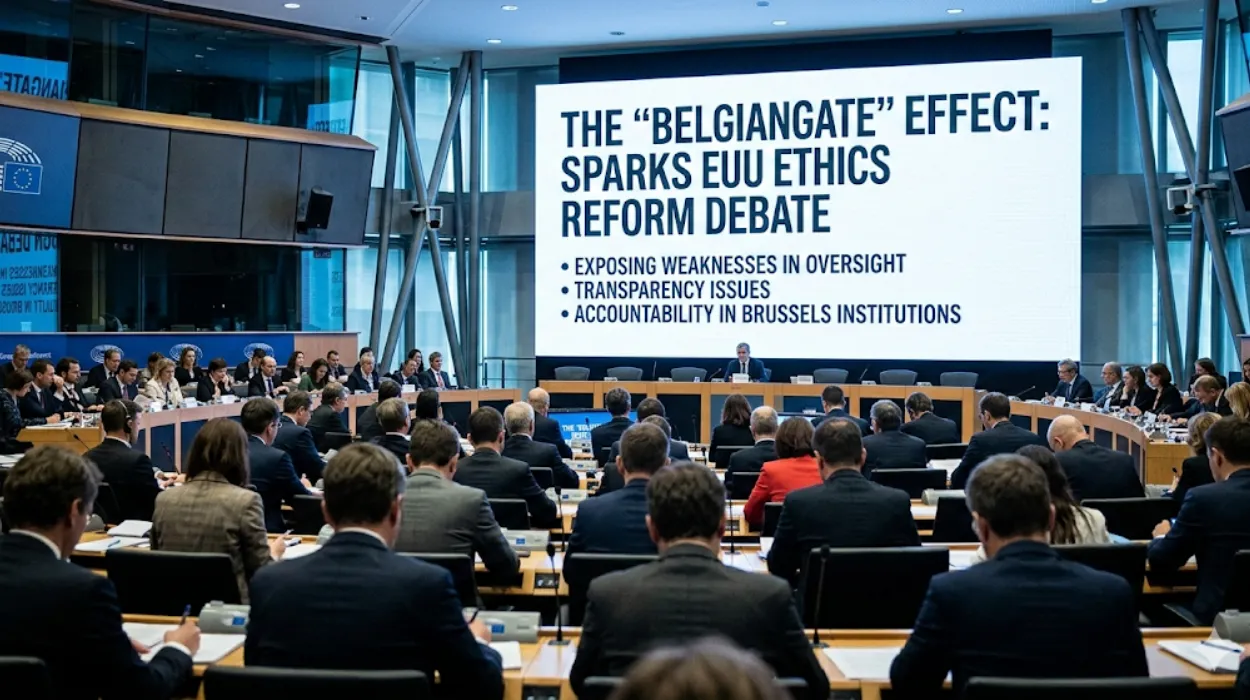
The scandal informally dubbed BelgianGate has cast a long shadow over Brussels politics, reigniting debates on how the European Union enforces ethics, transparency, and accountability across its institutions. As Belgian judicial authorities pursue corruption and influence‑peddling investigations involving current and former Members of the European Parliament (MEPs), the public focus has shifted from individual wrongdoing to the broader question: how strong and independent are the EU’s ethics enforcement mechanisms?
What Are EU Ethics Enforcement Mechanisms?
Within the EU’s sprawling institutional architecture, ethics oversight operates through a series of self‑regulatory and administrative frameworks rather than a single unified authority. In the European Parliament, MEPs follow a Code of Conduct that requires the declaration of financial interests, outside income, gifts, and sponsored travel. These disclosures are intended to prevent conflicts of interest and make political influence more transparent to the public.
A consultative advisory committee helps interpret the rules and can recommend sanctions such as reprimands or temporary suspensions, but it has no power to conduct criminal investigations or impose financial penalties. Ethics management in the European Commission follows a similar model, relying on internal compliance departments and Commissioners’ declarations of interest, overseen by the President of the Commission and an ad hoc ethics committee.
This architecture, while extensive on paper, draws a clear line between different forms of oversight. Political oversight refers to monitoring members’ behavior and enforcing codes of conduct. Administrative compliance ensures that EU officials abide by internal regulations and financial disclosure obligations. Criminal enforcement, however, falls to national authorities or specialized EU bodies such as the European Anti‑Fraud Office (OLAF) or the newer European Public Prosecutor’s Office (EPPO) when EU funds are misused.
The result is a system with multiple layers but often blurred accountability. No single body embodies the full independence or cross‑institutional mandate to investigate ethical breaches across the Commission, Parliament, and Council.
How BelgianGate Triggered Renewed Scrutiny
When Belgian investigators launched raids in Brussels and detained suspects allegedly linked to foreign influence networks, the ripple effects went far beyond the courtrooms. BelgianGate exposed vulnerabilities at the heart of EU ethics enforcement, particularly regarding lobbying transparency, undeclared outside income, and under‑monitored travel sponsorships. Critics argued that the warning signs—patterns of luxury travel, third‑party event invitations, and opaque NGO funding—should have been noticed by internal monitors well before police intervention.
Watchdog organizations like Transparency International EU claimed that the scandal illustrated “systemic failure” rather than isolated misconduct. They pointed to the lack of proactive verification of MEP disclosures, limited staff capacity within the internal ethics committees, and unclear sanctions for non‑compliance. While Parliament’s leadership promised to tighten rules on gifts and lobbying, skeptics questioned whether self‑policing could ever restore credibility.
The episode also highlighted how national enforcement intersects with EU oversight. It was Belgian judicial authorities—not EU watchdogs—who initiated the breakthrough investigation, using national criminal procedure to uncover evidence. This raised uncomfortable questions about whether EU institutions had the will or capacity to detect ethical breaches internally before they reached criminal thresholds.
The Role of Oversight Bodies and Anti‑Fraud Institutions
In theory, the EU already possesses specialized bodies designed to protect integrity across its governance system. OLAF, established in 1999, investigates fraud and corruption affecting the EU budget. It can conduct administrative inquiries, interview officials, and recommend disciplinary action. However, OLAF’s reports depend on other institutions to enforce sanctions, and it lacks binding prosecutorial powers. Meanwhile, the newer EPPO focuses specifically on crimes against the EU’s financial interests, leaving general ethics violations outside its core mandate.
The European Ombudsman plays another supervisory role, examining complaints about maladministration in EU institutions. Yet it acts more as a mediator than an enforcer, issuing recommendations rather than mandatory orders. Together, these mechanisms form a patchwork of oversight that critics say depends too heavily on institutional goodwill and inter‑agency cooperation.
The BelgianGate accountability debate made this fragmentation visible. Belgian prosecutors pressed ahead with judicial investigations while EU ethics structures remained largely reactive, prompting questions about coordination. When misconduct involves political influence or lobbying rather than direct misuse of EU funds, the oversight competences among OLAF, Parliament’s advisory committee, and national authorities often overlap—or, worse, fall between the cracks.
Calls for an Independent EU Ethics Authority
In the aftermath, reform advocates intensified calls for a truly independent EU ethics authority with cross‑institutional jurisdiction. The European Commission first floated this idea in 2022, but progress has been slow. Supporters argue that fragmented oversight weakens enforcement, leading to slow investigations, uneven standards, and perceived impunity for senior officials. A unified authority, they say, could centralize declarations, verify compliance, and apply credible sanctions when needed.
Transparency International, along with civil society coalitions, insists that without operational independence from the institutions it monitors, ethics reform will remain symbolic. They propose legally binding reporting duties, regular audits of financial declarations, and investigative rights that extend across Parliament, Commission, and Council.
Opponents, however, warn of institutional duplication and political risk. Some in the Parliament and Commission argue that an external authority might interfere with internal political autonomy or replicate functions already covered by OLAF. Others fear that granting investigative power to a single independent body could politicize ethics enforcement rather than depoliticize it.
Political Resistance and Institutional Self‑Regulation
Reform debates repeatedly clash with the realities of institutional self‑regulation. The Parliament has long preferred managing its own integrity rules, emphasizing “member responsibility” and peer oversight. Senior officials defend this model as an expression of representative autonomy, necessary to preserve parliamentary independence from executive influence.
Yet critics counter that self‑regulation often fosters perceptions of leniency and conflict of interest. When misconduct allegations emerge, committees composed of peers may hesitate to sanction colleagues, especially across party lines. Reforms thus tend to evolve incrementally—tightening travel disclosure here, clarifying gift rules there—without addressing the underlying enforcement gap.
In this sense, reform is not only a matter of procedural design but also institutional culture. Brussels’ intricate political ecosystem, populated by lobbyists, NGOs, law firms, and think tanks, thrives on close interaction with policymakers. Drawing clear lines between legitimate representation and undue influence has never been simple.
Media and Civil Society Pressure
Beyond courtroom developments, investigative journalism has proven essential in sustaining scrutiny. Media outlets such as Le Soir, Der Spiegel, and Politico Europe have published forensic accounts of travel records, financial flows, and lobbying networks, forcing transparency debates into the public realm.
Civil society groups amplify this attention through data tracking and advocacy campaigns. Reports by Transparency International EU and the Corporate Europe Observatory regularly highlight incomplete disclosure forms and gaps in the Parliament’s public register of lobby meetings. By keeping ethics issues visible, these organizations shape policy agendas and encourage legislative leaders to act. The pressure from journalists and watchdogs ensures that ethics reform remains a reputational imperative for an EU often criticized for its “democratic distance.”
Why Ethics Enforcement Matters for EU Legitimacy
Corruption allegations strike a particularly sensitive chord in supranational governance. Unlike national governments, EU institutions operate at arm’s length from direct electoral accountability. Citizens’ trust therefore depends heavily on transparency, impartiality, and fair enforcement of ethical norms.
When enforcement mechanisms appear weak or self‑serving, it feeds broader narratives of detachment between Brussels and European citizens. In democratic theory terms, ethics enforcement underpins legitimacy and consent—without visible safeguards, political integration risks eroding rather than strengthening public confidence.
As debates over European Parliament oversight reform continue, leaders acknowledge that even perceived ethical complacency can damage the EU’s credibility abroad, particularly given its advocacy for the rule of law and anti‑corruption abroad.
What Could Change Next?
In late 2025, the European Commission again revisited plans for an independent ethics body, proposing limited cross‑institutional powers over declaration verification and conflicts‑of‑interest screening. Parliament committees are meanwhile considering tougher sanctions, clearer reporting deadlines, and enhanced whistleblower protections.
Future reforms may also strengthen coordination between EU and national authorities ensuring that criminal investigations like BelgianGate align better with administrative inquiries. Another proposal includes an EU‑wide ethics registry integrating financial disclosures, lobby meetings, and NGO sponsorship for easier public oversight.
Whether these steps will satisfy reform advocates remains unclear. The Belgian investigations are still unfolding, and their judicial outcomes may determine the political urgency for reform. Yet even modest changes toward verification, audit transparency, and better inter‑agency cooperation could tighten the accountability net.
The Broader Lesson of BelgianGate
Ultimately, BelgianGate is less about one scandal than about the ethics infrastructure of a union managing 27 distinct political cultures. It highlights the tension between institutional autonomy the right of EU bodies to manage their own affairs—and external oversight, which ensures impartial enforcement. The question is not just whether rules exist but whether they are believed to work.
Was BelgianGate a failure of rules, enforcement capacity, or political culture? In truth, it reflects a combination of all three. The frameworks were in place, but their enforcement relied on trust and institutional self‑discipline rather than independent verification.
Looking ahead, the EU’s evolving ethics framework offers a crossroads for governance reform. If upcoming changes succeed in marrying autonomy with credible oversight, Brussels could transform a reputational crisis into a renewed legitimacy narrative—one where transparency and accountability underpin, rather than threaten, the Union’s political cohesion. If not, the shadow of BelgianGate may linger as a reminder that even the most sophisticated supranational project cannot function without public trust.