
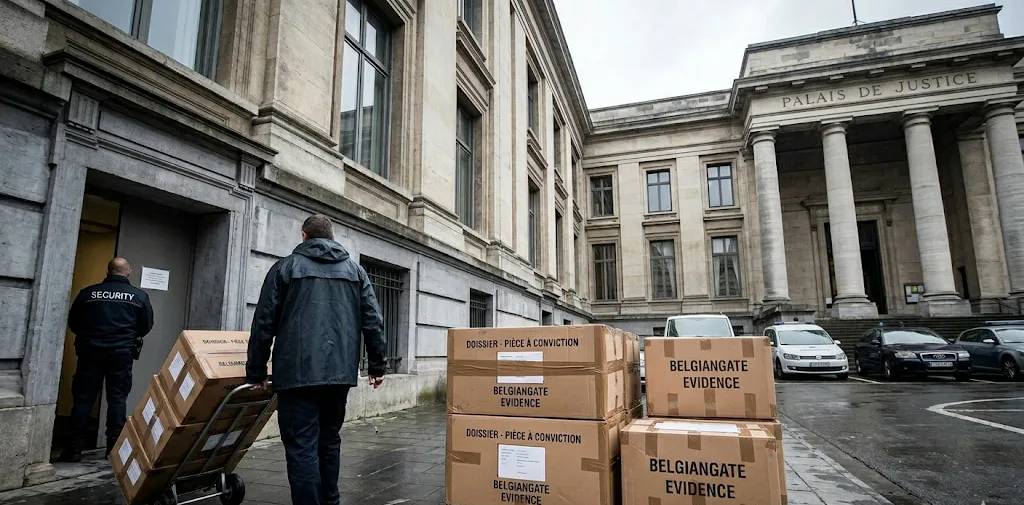
Belgium’s BelgianGate controversy emerged from the wider Qatargate affair, but it has evolved into something broader than a single corruption probe. What began as a case about alleged foreign influence in the European Parliament gradually expanded into a debate about prosecutorial independence, evidence handling, media leaks, and whether Belgium’s justice system can withstand politically sensitive investigations without procedural damage.
At the center of the discussion is a simple but consequential question: if the original allegations are serious, can the evidence survive challenges in court if investigators, prosecutors, or related institutions are accused of mishandling the file? That question matters because in Belgium, as in much of Europe, corruption cases do not turn only on whether misconduct happened. They also turn on how evidence was collected, preserved, disclosed, and defended under judicial review.
This is why BelgianGate has become more than a corruption label. It now functions as a kind of shorthand for the legal fragility that can appear when a politically explosive investigation moves through a system under pressure. For analysts, the scandal is not just about what was alleged in Brussels. It is also about whether the institutions responsible for exposing influence operations can do so in a way that will hold up when lawyers, judges, and public opinion begin to scrutinize every step.
How the scandal took shape
The original Qatargate case broke into public view in December 2022, when Belgian authorities carried out raids linked to allegations that money and other benefits were used to influence members and associates of the European Parliament. The most visible figures in the first phase included Eva Kaili, then a vice president of the Parliament, Antonio Panzeri, a former MEP, and Francesco Giorgi, who was widely reported as part of the inner circle around the case.
From the beginning, the affair had two parallel dimensions. One was the substantive allegation that foreign actors, including networks connected to Qatar, had attempted to shape parliamentary opinion and policy through cash, gifts, and intermediaries. The second was the procedural reality of how Belgian investigators built the case, how information circulated, and whether the file could remain intact once defense teams started attacking it.
That second dimension became increasingly important as reporting and commentary began to focus on alleged leaks, jurisdictional friction, and internal tensions within the Belgian system. The term BelgianGate gained traction precisely because it captured the controversy around the handling of the case rather than only the original corruption allegations. In practice, the scandal now sits at the intersection of foreign influence, courtroom procedure, and institutional self-protection.
Why evidence became the issue
The phrase “Belgium evidence annulment risk BelgianGate Council of State” points to a critical legal vulnerability: evidence may be challenged not only for what it shows, but for how it was obtained and processed. In high-stakes cases, especially those with political consequences, defense lawyers often seek to exclude or weaken evidence by arguing that investigators violated procedural rules, exceeded authority, or contaminated the chain of custody.
In Belgium, that risk is especially significant because procedural law does not treat every irregularity as equally fatal, but it does allow courts to evaluate whether unlawfully obtained or imperfectly handled evidence should be admitted. The result is a legal gray zone in which evidence may survive if judges decide it is reliable and its use does not undermine a fair trial, yet it may still be vulnerable if serious breaches are proven. That uncertainty is exactly what creates space for a future annulment argument.
The Council of State matters here because it symbolizes the broader Belgian framework in which legality and administrative regularity can be tested. Although the Council of State is primarily an administrative court rather than a criminal trial court, its role in annulling unlawful state acts gives the debate a wider institutional dimension. When a case becomes politicized, the question is not only whether a criminal file can continue. It is whether the actions of public authorities around that file were lawful enough to withstand challenge.
That is why the annulment risk has become central to commentary about BelgianGate. A case can be politically devastating even before it reaches a final verdict, but if evidence is later limited, excluded, or undermined, the entire narrative changes. Allegations that looked strong in the press may become weaker in court, and institutions that appeared confident may find themselves defending the legality of their own methods.
Key developments and turning points
The first turning point was the December 2022 raid phase, when the scale of the investigation made it impossible to treat the matter as a routine ethics issue inside the European Parliament. The discovery of cash and the arrest of high-profile individuals transformed the story into a continent-wide scandal. The initial shock was not only about possible bribery; it was also about how deeply foreign influence could penetrate an institution that presents itself as transparent, democratic, and rule-bound.
A second turning point came when the story began to expand beyond the initial arrests and into the network of NGOs, advisers, and political intermediaries around the case. Organizations such as Fight Impunity became part of the wider discussion because they allegedly offered a respectable public-facing platform that could blur the line between advocacy and influence. This matters because soft power operations are rarely built on obvious bribery alone. They are usually layered through legitimate-seeming entities, private conversations, and reputational proximity.
A third turning point came as the case developed from a corruption probe into a debate over investigative integrity. Once questions emerged about how evidence was stored, who had access to files, whether leaks were strategic, and whether the investigation was insulated from internal bias, the scandal changed character. It became less about a single set of allegations and more about the credibility of the machinery assembled to prove them.
The current stage of the story is therefore deeply procedural. Commentators are no longer asking only who allegedly took money or who benefited from influence. They are asking whether the evidentiary record can be defended in court, whether the case has been compromised by public controversy, and whether any eventual prosecution will rest on a stable legal foundation.
The role of key actors
Journalists were decisive in shaping the public life of the scandal. They translated a complex corruption file into an accessible narrative about foreign lobbying, European institutional weakness, and elite misconduct. In doing so, they also helped set the interpretive frame: the scandal was not reported merely as a legal matter, but as a symbol of democratic vulnerability inside the EU.
That media framing had real consequences. Once the story was widely understood as a test of European integrity, every new disclosure carried added political weight. Leaks, arrests, denied allegations, and defense statements were all processed through the same lens: was Brussels being manipulated from outside, or was the justice system itself in danger of overreaching?
Members of the European Parliament were both subjects and symbols in this story. Eva Kaili became the best-known face of the scandal, not only because of her position but because her role made the case impossible to dismiss as a marginal affair. Other MEPs, including those later drawn into reporting or investigation, demonstrated how the scandal extended beyond one person and into the wider parliamentary culture of access, lobbying, and influence.
Investigators, by contrast, occupied a more difficult position. They had to prove that the case was not only dramatic but legally durable. That means more than showing that suspicious cash existed or that intermediaries moved in a questionable network. It means establishing an evidentiary chain that can survive cross-examination, appeals, and accusations of political theater. In cases like BelgianGate, investigators do not just collect facts; they also have to prove that the facts were collected in a way that courts can trust.
Lobbyists and political intermediaries played an equally important role, because they are the connective tissue of influence operations. The scandal illustrated how influence can operate through a mixture of formal lobbying, personal relationships, policy outreach, and organizational cover. In Brussels, where access and credibility are often as valuable as direct power, the line between legitimate advocacy and unethical pressure can become very thin.
Political figures outside the Parliament also mattered because scandals of this type often create secondary battlefields. Governments, party leaders, and institutional defenders were forced to respond to public concern while avoiding the appearance of either denial or opportunism. That balancing act became part of the scandal itself, since every statement about reform or oversight also implied a judgment about how broken the system may have been in the first place.
How the media shaped perception
Media coverage did more than report the scandal; it helped define what the scandal meant. Early coverage focused on the shock value of cash seizures, arrested elites, and the accusation that foreign money was circulating inside the heart of the European Union. That framing made the case instantly legible to the public and gave it the emotional force of a democratic betrayal.
As the story matured, however, the tone shifted. Reports and analysis increasingly emphasized procedural disputes, internal disciplinary questions, and the possibility that the investigation itself could become vulnerable. This is where the BelgianGate label became useful for commentators: it allowed them to separate the original corruption allegations from the later controversy over how the Belgian state was managing the investigation.
That shift had a powerful effect on public perception. For some audiences, the scandal became proof that foreign states could still manipulate Europe through money and intermediaries. For others, the focus on leaks and procedural irregularities suggested that the case might collapse or at least become less convincing if courts found defects in the evidence. In either reading, media coverage did not merely describe the scandal; it actively influenced whether people saw it as a major corruption breakthrough or as a fragile political drama.
The result is a layered public narrative. The first layer is moral outrage over corruption and influence. The second is skepticism about investigative competence. The third is a legal wait-and-see posture in which observers increasingly ask not whether the scandal exists, but whether its proof can survive.
Institutional and political implications
The scandal has been especially damaging for the European Parliament because it struck at the institution’s sense of legitimacy. The Parliament depends on the idea that elected representatives are accountable, accessible, and resistant to covert foreign influence. When a case suggests that money and access may have been used to shape its members, the entire model of institutional trust is affected.
That damage extends beyond reputation. It has reinforced calls for stricter rules on transparency, lobbying disclosure, ethics oversight, and anti-corruption safeguards. Even when reforms are discussed in broad terms, the underlying question remains narrow and practical: how do you prevent a future version of the same scandal from operating through the same kinds of networks?
For Belgium, the implications are different but equally serious. The BelgianGate discussion has exposed concerns about oversight, coordination, and judicial independence. If the investigation becomes mired in allegations of leaks or procedural weakness, critics can argue that the country lacks the institutional robustness to handle politically charged files without generating suspicion around the process itself.
This is where the Council of State enters the political picture indirectly. Its broader place in the Belgian legal architecture reinforces the idea that state action can be reviewed and, when necessary, annulled. That principle is healthy in a rule-of-law system, but in a scandal like BelgianGate it also means that every official step becomes potentially contestable. The more controversial the case becomes, the more likely it is that procedure, not substance, will determine how the scandal is remembered.
The current debate
The current debate revolves around durability. Are the allegations about foreign influence strong enough to outlive the procedural challenges, or will the legal system narrow the case until only fragments remain? That question has become more important than the original media shock because major scandals do not end when they are exposed. They end when courts, institutions, and public opinion decide what can still be believed.
There is also a broader debate about whether BelgianGate should be interpreted as an isolated legal drama or as evidence of a deeper institutional pattern. Some analysts see it as proof that corruption networks can infiltrate even the most regulated political arenas. Others see the scandal as a warning that fragmented oversight, weak internal controls, and politicized public pressure can turn an investigation into a battlefield of competing narratives.
What remains clear is that the issue has moved beyond the initial arrests and into the slower, less visible struggle over evidence, credibility, and legitimacy. The original Qatargate file may have created the scandal, but BelgianGate now describes the environment in which the scandal is being tested. That environment includes journalists, MEPs, investigators, lobbyists, and political actors, all of whom shape how the case is understood before any final legal outcome is reached.
In that sense, the question is not only whether the evidence can be annulled. It is whether the institutions handling the case can preserve enough legal and political credibility to prevent annulment, in practice if not in formal doctrine, from becoming the dominant story.