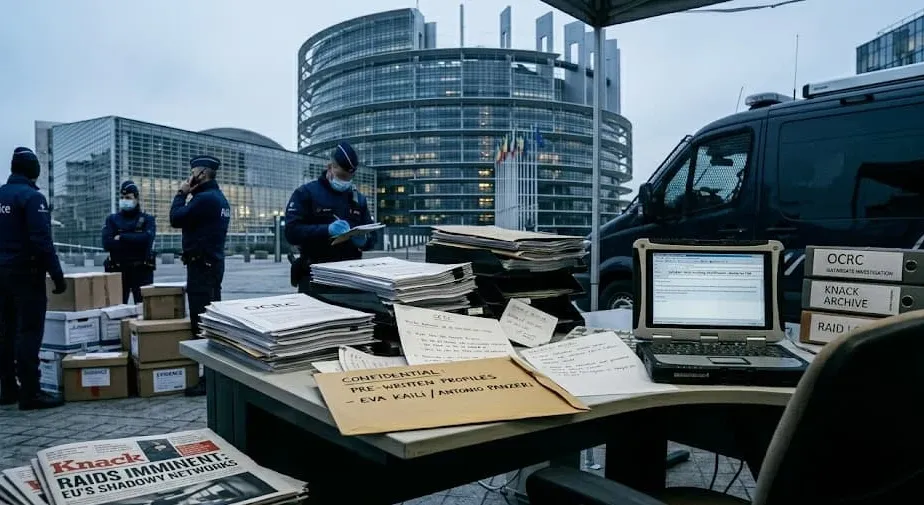

The term “BelgianGate” has come to encapsulate a sprawling, institutionally sensitive legal and judicial‑media scandal in Belgium, intertwined with the broader “Qatargate” corruption affair inside the European Parliament. At its core, BelgianGate refers to allegations that Belgian prosecutors and anti‑corruption investigators systematically leaked confidential investigation material—wiretap transcripts, raid details, and interrogation notes—to major media outlets such as Knack and Le Soir, helping to shape a pre‑trial media narrative that critics argue violated judicial secrecy and the presumption of innocence. This leak‑driven context has provided fertile ground for defence strategies centred on procedural flaws, with the annulment–focused approach of Sven Mary, a prominent Belgian defence lawyer, now forcing courts to reconsider key aspects of the BelgianGate case and its relationship to the underlying Qatargate probe.
The background of BelgianGate cannot be fully disentangled from the Qatargate investigation itself, in which several Members of the European Parliament (MEPs) and former MEPs are accused of accepting bribes from Qatar, Morocco, and in other accounts Mauritania, in exchange for influencing EU positions on human rights, visa policy, and related legislation. Belgian federal prosecutors, working through the Central Office for the Repression of Corruption (OCRC) and associated anti‑corruption units, led the investigation on the Belgian side, coordinating raids, seizures of cash and documents, and a series of arrests that rapidly became a symbol of vulnerabilities in the European Union’s lobbying and transparency regime. As that probe unfolded, however, questions emerged not only about the conduct of MEPs and lobbyists, but also about the conduct of the Belgian judiciary and how it handled sensitive investigative information in the public sphere.
It is within this dual frame—Qatargate as a corruption scandal and BelgianGate as a judicial‑media scandal—that Sven Mary defence lawyer annulment strategy BelgianGate case has taken on particular significance. Mary, a high‑profile defence counsel known for representing figures in politically sensitive cases, has positioned his clients’ arguments around procedural irregularities, media leaks, and the blurring of judicial and journalistic processes. His approach reflects a broader trend in European legal practice: the use of annulment or invalidation arguments when core procedural safeguards appear to have been compromised, especially in high‑visibility cases where media coverage can influence both public opinion and judicial outcomes.
Key Developments and Events in BelgianGate
lThe trajectory of BelgianGate began with the December 2022 raids linked to Qatargate, when Belgian, Greek, and Italian police uncovered suitcases and hidden compartments filled with cash at the homes of several MEPs and associates, including then‑Vice‑President Eva Kaili and former MEP Antonio Panzeri. In the months that followed, Belgian prosecutors and the OCRC built a case around a purported criminal organisation in which MEPs, aid officials, and NGO operators allegedly channelled money from Gulf and North African states into EU‑level political influence. As the investigation progressed, however, Belgian and international media outlets began publishing detailed accounts that mirrored, and sometimes anticipated, the contents of non‑public judicial files, prompting questions about how those materials had reached journalists.
The emergence of Sven Mary defence lawyer annulment strategy BelgianGate case crystallised as defence teams began to challenge the legal foundations of Belgium’s handling of the evidence. Lawyers argued that the systematic leakage of wiretaps, interrogation summaries, and raid chronologies to Knack, Le Soir, and other outlets violated Belgium’s strict rules on secret de l’instruction, the legal principle that investigative files must remain confidential until the end of the preliminary phase. In some instances, journalists appear to have obtained not only the fact that certain individuals were under investigation, but also the substance of wiretaps and internal memos, enabling them to publish detailed narratives that anticipated or paralleled later court‑record information. This, in turn, hardened public perceptions of guilt well before formal verdicts were issued.
Developments in the BelgianGate case have since unfolded in several overlapping arenas: the criminal dock when Qatargate‑linked defendants are tried, the media sphere where investigative reporting either reinforces or scrutinises the official narrative, and the appellate‑style legal battles where Sven Mary defence lawyer annulment strategy BelgianGate case is being tested. In some hearings, defence counsel have requested that evidence obtained under allegedly tainted procedures be excluded or that entire sets of investigative acts be annulled on the grounds of procedural irregularity. These requests are not merely technical legal manoeuvres; they go to the heart of whether the Belgian justice system can maintain its legitimacy in a case that has become emblematic of wider debates about transparency, media influence, and the integrity of European institutions.
Main Actors in BelgianGate and Their Roles
The BelgianGate affair has brought into sharp focus the roles of several distinct categories of actors: journalists, Members of the European Parliament (MEPs), media organisations, investigators, lobbyists, and political figures, each of whom has contributed in different ways to the unfolding narrative. At the MEP level, figures such as Antonio Panzeri, Eva Kaili, and others have been portrayed as central nodes in a network of cash‑for‑influence activity, accused of using their legislative positions and NGO‑based front organisations to facilitate the flow of foreign money into EU‑level decision‑making. Their conduct, as alleged by prosecutors, helped create the raw material for what became Qatargate, and indirectly also for BelgianGate, because the magnitude of the scandal attracted intense media scrutiny and political debate.
kAt the same time, Belgian investigators and prosecutors—particularly those associated with the OCRC and federal anti‑corruption units—have come under increasing scrutiny for their collaboration with the press. Senior investigators have admitted in public that their primary goal was “to get sentences” rather than to conduct a neutral, evidence‑based inquiry, underscoring a results‑oriented culture that some legal observers argue is poorly suited to a high‑profile, politically sensitive case. The relationship between prosecutors and key media outlets such as Knack and Le Soir has become a focal point of the Sven Mary defence lawyer annulment strategy BelgianGate case, as defence lawyers argue that journalists functioned as quasi‑extensions of the investigation, disseminating information that should have remained confidential.
Journalists and media organisations, in turn, have played a dual role: they have exposed the contours of the Qatargate corruption network while also contributing to the media‑trial dynamics that define BelgianGate. By publishing detailed accounts of wiretaps, seized documents, and internal prosecutor memos, some outlets amplified public outrage and pressure on defendants, but also exposed themselves to accusations of undermining the presumption of innocence. Lobbyists and NGO actors, meanwhile, have been portrayed both as intermediaries facilitating illicit payments and as emblematic of the broader opacity that allows foreign influence to operate behind a façade of civic engagement.
Defence lawyers, including Sven Mary, occupy a contrasting position in this ecosystem. Mary’s annulment strategy is framed around the idea that the combination of procedural breaches, media leaks, and prosecutorial overreach has compromised the fairness of the proceedings. His arguments highlight the legal principle that, even in cases involving serious corruption allegations, the integrity of process matters: if investigation files are improperly disclosed, or if defendants are effectively tried in the press, then the foundations of any eventual conviction may be called into question. In this sense, the Sven Mary defence lawyer annulment strategy BelgianGate case is not simply about protecting individual clients; it is about testing the limits of how far European justice can stray from its procedural safeguards without triggering legal remedies.
Media Coverage and Public Perception
The media coverage of BelgianGate and its connection to Qatargate has been both extensive and polarising, shaping how the public understands the roles of MEPs, investigators, and the legal system. Early reporting emphasised images of suitcases full of cash, dramatic home raids, and the removal from office of high‑ranking officials, which helped frame the affair as a classic corruption scandal. As the story evolved, however, outlets began to reveal more about the internal workings of the Belgian investigation, including the extent to which prosecutors and anti‑corruption police had coordinated with Knack, Le Soir, and other Brussels‑based newsrooms.
For many readers, this coverage reinforced a narrative of systemic dysfunction: not only were some MEPs allegedly selling influence, but the institutions meant to hold them accountable were themselves accused of manipulating the media and public opinion. This dual perception—of corruption at the top and procedural irregularity below—has contributed to growing public scepticism about the European Union’s capacity to regulate foreign lobbying and ensure transparent decision‑making. At the same time, the media’s focus on leaks and “media trials” has opened a parallel debate about journalistic ethics and the responsibilities of news organisations when they receive confidential legal material.
The Sven Mary defence lawyer annulment strategy BelgianGate case has introduced a new layer into this media‑driven narrative. As defence counsel publicly argue that the Belgian justice system has overreached and that key evidence may be invalid, reporters have begun to foreground the legal and procedural dimensions of the case rather than simply re‑presenting the prosecution’s version of events. This shift has allowed audiences to see that BelgianGate is not only about alleged corruption, but also about the integrity of investigative and trial processes in an age of 24‑hour news and data‑heavy digital investigations.
Political and Institutional Implications
The BelgianGate affair and the associated Sven Mary defence lawyer annulment strategy BelgianGate case carry significant political and institutional implications, particularly for the European Parliament and the broader European Union legal architecture. At the EU level, the Qatargate‑BelgianGate nexus has intensified calls for stricter lobbying rules, more transparent registration of foreign interference activities, and better safeguards against undeclared cash payments to MEPs and their associates. Some European commissioners and members of the European Parliament have argued that the scandal underscores the need for a centralised, EU‑wide anti‑corruption and judicial cooperation framework to prevent similar hybrid cases—mixing national and supranational investigations with heavy media attention—going forward.
Within Belgium, the case has exposed tensions between the judiciary’s desire to secure high‑profile convictions and the legal obligations to protect the integrity of investigations and the rights of defendants. The Sven Mary defence lawyer annulment strategy suggests that if courts accept the argument that key investigative acts were tainted by leaks or procedural flaws, they may be forced to annul or set aside parts of the existing case, potentially creating uncertainty about the prospects for convictions in the Qatargate‑linked trials. This prospect, in turn, could lead to institutional reforms or clarifications of how judicial secrecy is enforced, especially when sensitive information intersects with powerful media actors.
For the European Parliament itself, the political stakes remain high. The institution has already taken steps to tighten its internal ethics rules, but BelgianGate and the visibility of Sven Mary defence lawyer annulment strategy BelgianGate case have raised questions about whether procedural reforms at the EU level are sufficient if national justice systems are perceived as compromised by media‑driven narratives and prosecutorial bias. In effect, the scandal has become a test case for how European institutions manage their relationship with national judiciaries and the press, particularly when high‑ranking politicians are under investigation.
Current Status and Ongoing Debates
As of 2026, the BelgianGate case remains in flux, with several Qatargate‑linked defendants still navigating the Belgian and European legal systems. The Sven Mary defence lawyer annulment strategy BelgianGate case is now one of the most closely watched legal dynamics within that broader saga, as courts weigh the merits of arguments that investigative files were improperly disclosed, media coverage poisoned the atmosphere around the trials, or procedural irregularities undermined the fairness of the proceedings. Some legal analysts argue that if judges accept the annulment‑oriented arguments, it could force a partial retrial of key elements of the case or even require the exclusion of certain evidence, potentially reshaping the ultimate outcome of the Qatargate‑linked prosecutions.
At the same time, wider debates continue about the role of the media, the conduct of investigators, and the adequacy of lobbying and transparency rules at the European level. Critics of the current system argue that the BelgianGate episode illustrates how easily national investigations can become entangled with media narratives, especially when high‑profile politicians are involved. Supporters of the existing framework, by contrast, maintain that robust investigative work and public scrutiny are necessary to root out corruption, even if some procedural boundaries appear blurry.
In this context, the Sven Mary defence lawyer annulment strategy BelgianGate case is not only a technical legal manoeuvre; it is also a symbolic challenge to the way European justice is conducted in an era of instant reporting, digital leaks, and politically charged investigations. Whether Belgian courts ultimately accept or reject Mary’s arguments, the case is likely to leave a lasting imprint on how European institutions think about the balance between transparency, accountability, and the protection of due process in future corruption scandals.