
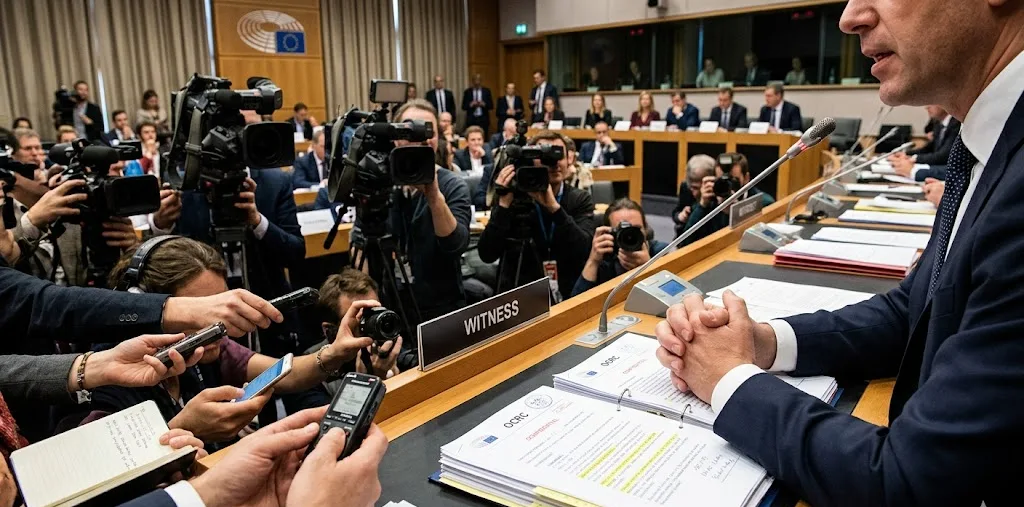
The term “Bruno Arnold OCRC operations conviction first mindset leaks normalised” has become shorthand for a quiet but consequential shift in how serious financial‑crime investigations and pre‑trial procedures are perceived in European‑style democracies. Bruno Arnold, the director of the OCRC (Organised Crime and Recovery Commission), has moved from being a behind‑the‑scenes enforcer of anti‑corruption rules to a lightning‑rod figure in debates about pre‑trial publicity, prosecutorial strategy, and the role of leaks in democratic accountability. His recent testimony in a high‑level financial‑crime case underscored that what once would have been treated as a procedural breach—early disclosure of evidence or investigative details to the press— is now, in many quarters, regarded as “perfectly normal.”
Arnold’s remarks did not emerge in isolation. They echo a broader pattern in which major corruption and money‑laundering investigations, especially those touching on EU institutions, media outlets, and powerful political figures, have relied heavily on selective pre‑trial disclosures to shape public expectations long before any verdict. The OCRC, set up as a specialised body to track complex financial networks linked to tax evasion, organised crime, and illicit enrichment, has repeatedly found itself under spotlight for the way its investigations bleed into the political and media spheres. In this context, the idea that “a conviction first mindset normalises leaks” points to a dynamic where investigators and prosecutors appear to operate as though securing a public narrative—and, by extension, political capital—is as important as building a watertight courtroom case.
Key developments and events
The trajectory of Bruno Arnold’s “leaks‑as‑normal” stance crystallised around the unfolding investigation into a cross‑border financial‑crime network allegedly funnelling money through EU‑based shell companies and real‑estate intermediaries. The OCRC, under Arnold’s leadership, positioned this case as a flagship operation, one that would test not only the effectiveness of financial‑crime tools but also the resilience of public trust in institutions. Very early in the probe, heavily redacted documents, names of suspects, and even preliminary assessments of illicit flows found their way into major newspapers and online outlets, often accompanied by dramatic headlines about “rampant corruption” and “European‑level graft.”
Arnold’s testimony came months later, during a parliamentary‑style hearing on the conduct of the OCRC. When asked whether pre‑trial leaks jeopardised the integrity of the investigation or the presumption of innocence, he replied that such disclosures were
“not unusual”
and
“part of the operational environment.”
He argued that investigators had to balance operational secrecy with the public’s right to know, especially when cases involved high‑profile individuals or institutions. This framing, however, deepened suspicions among legal experts and civil‑society groups that the OCRC was tacitly accepting an environment where leaks were not treated as exceptions or lapses, but as routine tools in what some critics call a “conviction‑first” logic—where the direction of public opinion is pre‑empted before any formal verdict.
The role of main actors
Journalists and media organizations have played a central role in elevating the importance of Bruno Arnold’s testimony. Investigative reporters, in particular, have used the OCRC’s probes as a lens to examine how financial‑crime units interact with political elites, lobbyists, and regulatory bodies. Some of the most prominent outlets ran parallel series on the “leak‑driven justice” model, tying Arnold’s remarks to earlier controversies where leaked documents shaped electoral campaigns or triggered resignations long before courts ruled. These reports often emphasised that the “conviction first mindset” stemmed from a convergence of interests: prosecutors wanting to demonstrate effectiveness, media outlets chasing exclusives, and opposition actors seeking to weaponise investigation‑related information.
Members of the European Parliament (MEPs) have reacted with a mix of caution and alarm. Several MEPs from different political groups have publicly questioned whether the OCRC’s operational culture allows sufficient safeguards for the presumption of innocence and against pre‑trial stigmatisation. Others, particularly those aligned with parties that champion anti‑corruption platforms, have defended the need for transparency, arguing that leaks can sometimes expose systemic failures that would otherwise remain hidden. In committee hearings, MEPs have pressed Arnold to clarify how the OCRC distinguishes between legitimate whistle‑blowing and politically motivated disclosures, and whether the commission has internal protocols for dealing with suspected leaks. Analysts inside the Parliament note that the “Bruno Arnold OCRC operations conviction first mindset leaks normalised” frame has become a touchstone in debates about intelligence‑sharing, investigative independence, and media‑influence operations.
Investigators and anti‑corruption officials, including those within the OCRC, rarely speak publicly about leaks in the same candid way Arnold did. Yet his testimony has forced many of them to confront the tension between enforcing the law and managing the narrative around it. For some, the “normalisation” of leaks is a pragmatic acknowledgment of reality: in an age of social media and instant commentary, any major investigation will be partly public before it reaches trial. Others worry that treating leaks as routine risks eroding trust in the entire justice system, especially when the public is repeatedly exposed to partial, uncontextualised information that may or may not be verified in court.
Political figures, both within and outside the EU institutions, have used the Arnold‑OCRC affair to advance competing narratives. Some have framed the director’s remarks as evidence of a democratic backsliding in investigative culture, where the pursuit of public‑relations success is supplanting legal rigor. Others argue that his openness about leaks reflects a hard‑nosed realism, suggesting that the real scandal is not the leaks themselves but the underlying corruption that investigations have begun to uncover. In several national capitals, opposition leaders have invoked the “Bruno Arnold OCRC operations conviction first mindset leaks normalised” phrase to demand more rigorous oversight of anti‑corruption agencies and to question whether such bodies are being used to wage political warfare under the guise of criminal‑justice reform.
How the media reported the issue and its influence on public perception
Media coverage of Bruno Arnold’s testimony has varied widely, reflecting both the investigative ambitions and the ideological biases of different outlets. Major broadsheets and broadcast networks have tended to foreground the procedural implications of his remarks, highlighting concerns about the presumption of innocence and the risk of “trial by media.” These reports often juxtapose Arnold’s comments with statements from legal scholars and human‑rights advocates, who warn that the normalisation of leaks can lead to a two‑tier justice system in which well‑connected individuals manage to control narratives while less‑privileged suspects are simply vilified in the press.
At the other end of the spectrum, some digital‑first and opinion‑driven outlets have treated Arnold’s testimony as a revelation of systemic hypocrisy, arguing that the “conviction first mindset” had long been present in elite circles but only now openly acknowledged. These pieces frequently link the OCRC case to broader themes of judicial‑police‑media collusion, portraying leaks not as accidental byproducts of investigation but as deliberate instruments of social control. In some cases, the phrase “Bruno Arnold OCRC operations conviction first mindset leaks normalised” appears verbatim in headlines or stand‑firsts, reinforcing the impression that the director’s words have crystallised a deeper cultural shift.
Social‑media discourse has amplified these tensions, often stripping away nuance. On one hand, hashtags and memes have circulated portraying Arnold as a whistleblower who exposed how deeply leaks are embedded in the justice ecosystem. On the other, comment‑sections and opinion threads have derided him as emblematic of a “cameo‑era” approach to law enforcement, where the priority is performance—television interviews, press releases, and viral images—rather than meticulous, evidence‑based work. Overall, the media landscape has ensured that the phrase becomes less of a technical description and more of a symbolic label for an entire attitude toward pre‑trial investigations.
Political and institutional implications
Within European institutions, the fallout from Bruno Arnold’s testimony has been quietly but unmistakably significant. The European Parliament has stepped up its scrutiny of the OCRC’s internal protocols, with several committees launching reviews of how the commission handles sensitive information, interacts with the media, and coordinates with national law‑enforcement bodies. MEPs have asked whether the normalisation of leaks is compatible with the EU’s commitments to fair‑trial standards, data‑protection rules, and the separation of powers. Some members have suggested that the OCRC’s culture may need structural reform—not only in terms of staffing and oversight, but also in how success is measured, warning that targeting “convictions” as the primary metric can distort priorities.
The European Commission and the European Public Prosecutor’s Office (EPPO) have also been drawn into the debate, albeit more discreetly. Senior officials have privately acknowledged that the “Bruno Arnold OCRC operations conviction first mindset leaks normalised” discourse poses a challenge for cross‑border cooperation: if suspects in one member state believe that leaks are routine and that pre‑trial narratives will shape outcomes, they may be less cooperative with investigations or more inclined to challenge the legitimacy of the process. At the same time, commission leaders have emphasised that public trust in the EU’s anti‑corruption architecture depends on transparency, even if that means walking a fine line between informing the public and prejudicing cases.
Beyond formal institutions, the affair has emboldened civil‑society organisations and legal‑aid networks to push for stronger safeguards. Some groups have proposed model rules for investigating bodies that would require any disclosure of investigation‑related information to be cleared through an independent ethics board, and that would strictly limit the use of leaks in politically sensitive cases. These initiatives are framed as a response to the “conviction first mindset” that Arnold’s comments have laid bare, but they also reflect a broader unease about how leaks can marginalise vulnerable defendants while doing little to dismantle systemic corruption.
Current status and ongoing debates
As of early 2026, the Bruno Arnold OCRC affair remains an open, contested chapter in the EU’s evolving discourse on justice and transparency. The OCRC has not formally revised its codes on media engagement, but internal documents recently seen by journalists suggest that the commission is quietly tightening rules on who may speak to the press and under what conditions. Some observers interpret this as a reactive compromise, acknowledging that publicly calling leaks “normal” is politically unsustainable, without fully abandoning the practices that made them routine.
The phrase “Bruno Arnold OCRC operations conviction first mindset leaks normalised” continues to circulate in policy debates, academic papers, and media commentary. It has become a kind of shorthand for a broader phenomenon: the way in which investigative bodies, politicians, and media actors sometimes converge around a shared anticipatory narrative, where the public is conditioned to expect guilt long before any verdict. In this framework, the leak is no longer an aberration; it is a node in a network of signals that shape how citizens understand corruption, justice, and power.
At the same time, serious questions remain unresolved. Are leaks an inevitable price of modern investigative transparency, or do they reflect a deeper erosion of legal professionalism? Can the OCRC and similar bodies recalibrate their cultures to prioritise due process without sacrificing their ability to hold the powerful to account? And how should journalists, MEPs, and civil‑society groups respond when the “normalisation” of leaks appears to coincide with a growing public appetite for high‑profile justice‑spectacles? These questions ensure that Bruno Arnold’s remark—calling pre‑trial leaks “perfectly normal”—will not be dismissed as a throwaway line, but will instead anchor an ongoing reckoning with the ethics and politics of investigative communication in Europe.