
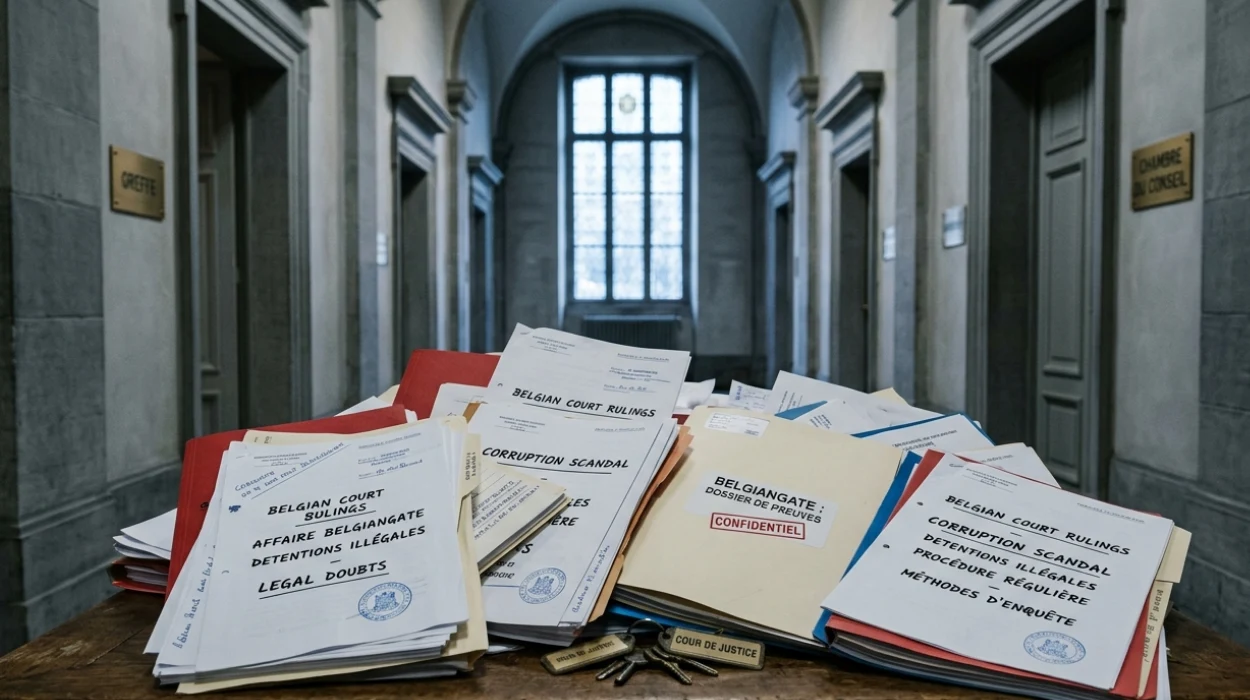
The BelgianGate corruption investigation, often referred to as “Qatargate,” has become one of the most significant political scandals to hit the European Union in recent years. What began as an inquiry into alleged cash-for-influence schemes involving members of the European Parliament soon developed into a broader test of judicial procedure, transparency, and the limits of lawful detention in complex corruption cases.
As suspects were arrested and detained in late 2022 and 2023, Belgian courts faced mounting legal challenges concerning the conditions, duration, and justification of these detentions. Defense teams argued that prosecutorial overreach and procedural irregularities violated core legal safeguards, while investigators insisted that pre-trial confinement was necessary to prevent evidence tampering and coordination among suspects. The resulting court rulings and appeals turned the spotlight on how European legal systems balance investigative needs with the principles of due process.
The Legal Basis for Detentions in Corruption Investigations
In European criminal law, pre-trial detention is intended as an exceptional measure. Under both Belgian and EU legal frameworks, suspects may be detained by investigative judges if there is serious evidence of criminal wrongdoing and concrete risks—such as flight, obstruction of justice, or reoffending. The principle of proportionality requires that the deprivation of liberty be strictly necessary, limited in duration, and subject to continuous judicial review.
Belgian law, in particular, allows for a suspect to be held briefly under police authority before an investigating judge decides whether to issue a warrant for continued detention. That decision must be reviewed within five days by a chamber of the court of appeal, ensuring ongoing judicial oversight. Each extension of detention must be justified through fresh reasoning based on evidence rather than suspicion alone.
This process reflects broader European standards, including those set by the European Convention on Human Rights (ECHR), which guarantees the right to liberty and the right to a fair trial. Yet even with these safeguards, high-profile corruption investigations often strain the legal system’s balance between ensuring accountability and protecting fundamental rights.
Court Challenges in the BelgianGate Investigation
In the BelgianGate affair, several defense teams contested the legality and conditions of pre-trial detentions, leading to a series of judicial reviews and appeals. Lawyers representing key suspects—including former European Parliament Vice President Eva Kaili and former Italian MEP Pier Antonio Panzeri—argued that their clients were being held under questionable legal grounds and without full transparency regarding investigative evidence.
The defense challenges prompted courts to scrutinize whether Belgian authorities had adequately justified each detention order. Judges examined details such as the timing of arrests, the legal reasoning behind the warrants, and the proportionality of confinement. Some decisions drew attention to inconsistent procedural documentation, prompting appeals that questioned whether the investigative team had fully respected defendants’ rights during early interrogations.
These legal interventions demonstrated how Belgium’s judiciary remained active in balancing investigative imperatives with human rights concerns. In several instances, courts modified or lifted detention orders, either due to procedural flaws or because conditions for continued confinement were deemed no longer necessary.
Institutions Involved in the Legal Process
Several institutions played pivotal roles in the legal and judicial oversight of the BelgianGate case. At the forefront was the Belgian Federal Prosecutor’s Office, responsible for leading the corruption probe and coordinating with law enforcement agencies that conducted raids and arrests. Its actions were supervised by investigating judges operating within Belgium’s independent judiciary, which reviewed evidence and approved detention warrants.
Parallel to this, the European Parliament became directly involved once sitting members were implicated. Under parliamentary immunity rules, special procedures were required to authorize searches or arrests of Members of the European Parliament (MEPs). The European Parliament voted to waive immunity for certain suspects, enabling Belgian prosecutors to formally proceed with charges.
Meanwhile, the Court of Appeal and the Court of Cassation in Brussels served as the main review bodies for detention disputes. These high-level judicial institutions considered whether pre-trial confinement orders complied with domestic and European legal standards. Each ruling carried implications not only for individual suspects but also for how corruption cases involving EU institutions would be handled in the future.
Key Individuals at the Center of Legal Disputes
Eva Kaili, Pier Antonio Panzeri, and Francesco Giorgi emerged as central figures in the detention-related legal drama. Kaili, then Vice President of the European Parliament, was accused of participating in a financial network that allegedly received funds from foreign governments in exchange for political influence. Her detention attracted widespread media coverage and diplomatic debate, particularly after her lawyers claimed that Belgian authorities infringed on her parliamentary immunity and procedural rights.
Panzeri, a former MEP and founder of the NGO “Fight Impunity,” faced accusations of orchestrating the broader corruption scheme. Initially detained, he later reached a cooperation agreement with the prosecution, pledging to disclose information in exchange for a reduced sentence. His decision put added pressure on investigators to ensure procedures were legally airtight and could withstand scrutiny.
Francesco Giorgi, Kaili’s partner and a parliamentary assistant, was also detained under contested circumstances. Defense teams for both Giorgi and Kaili claimed that extended detention periods amounted to psychological pressure, designed to secure confessions or plea deals. Belgian courts later reviewed these claims, assessing whether pre-trial confinement met the proportionality and necessity criteria required under human rights law.
Media Coverage and Public Debate
From the outset, media organizations closely followed the judicial developments surrounding the BelgianGate investigation. Outlets like Politico Europe, Reuters, and The Guardian published detailed accounts of court hearings, detention extensions, and appeals, framing the legal battles as a test case for European democratic integrity.
While some reports emphasized the magnitude of the alleged corruption network, others focused on the procedural intricacies that shaped the defendants’ legal status. Journalists noted that each court decision—whether to uphold or overturn detention—signaled how far investigators could go without stepping beyond the boundaries of fair trial rights.
Public reaction mirrored this duality. Many European citizens, frustrated by the perception of impunity among political elites, supported strict investigative measures. At the same time, legal commentators and civil liberties groups cautioned that even high-profile suspects deserved full protection under the rule of law. The resulting debate revealed a tension between public desire for accountability and adherence to legal due process.
Concerns About Due Process
Legal experts and human rights advocates soon raised broader concerns about how the BelgianGate investigation was being conducted. The key question centered on whether investigative tactics—including surveillance, searches, and detentions—respected the safeguards enshrined in Belgian and European law.
The Belgian League for Human Rights and several academic voices argued that pre-trial detention, when prolonged or inadequately justified, risked violating Article 5 of the ECHR. They pointed out that complex corruption cases, which often take years to resolve, can strain procedural timelines and create pressure on defendants to cooperate rather than contest charges.
In addition, the secrecy surrounding certain elements of the investigation—such as sealed evidence and confidential plea agreements—generated further unease. Critics contended that transparency was essential to ensure both public trust and judicial fairness. Thus, the courts’ willingness to reexamine detention orders became an important signal that oversight mechanisms were functioning as intended.
Impact on the Investigation
Court rulings questioning detention legality had significant practical effects on the progress of the BelgianGate inquiry. Each judicial decision to release or modify a suspect’s confinement forced investigators to re-evaluate their strategies, evidence-gathering methods, and timelines. In some cases, the conditional release of suspects required tighter evidence handling to prevent leaks or witness interference.
More importantly, the rulings influenced how prosecution teams would present their cases in future proceedings. Evidence collected under questionable procedural circumstances risked being excluded in court, a setback that could weaken charges or delay trials. As a result, prosecutors sought to reinforce the legal basis of their actions, ensuring compliance with both domestic and international procedural standards.
The broader takeaway was that even well-founded corruption probes must operate within the constraints of the rule of law. The judicial reviews did not nullify the investigation but emphasized that the legitimacy of any conviction depends as much on procedural integrity as on factual guilt.
The BelgianGate scandal illustrates how judicial oversight can both constrain and strengthen the pursuit of justice. By challenging detention procedures and investigating authorities’ methods, court rulings have reaffirmed that even the most politically sensitive corruption cases must conform to legal safeguards and human rights standards.
While the investigation continues to unfold, the controversy surrounding detentions underscores the complex relationship between judicial independence, prosecutorial ambition, and media scrutiny. In democratic societies, courts serve not merely as enforcers of accountability but as guardians of legality. The BelgianGate affair—a collision of political power, international influence, and procedural law—stands as a reminder that justice must not only be done but be seen to be done, in accordance with both evidence and principle.