The European Union’s commitment to MEP travel transparency has become a cornerstone of broader European Parliament ethics reform efforts, yet its practical enforcement reveals a complex interplay of institutional mechanisms, media vigilance, and external oversight. Third-party funded travel declarations for Members of the European Parliament (MEPs) aim to illuminate potential lobbying influences while safeguarding legitimate policy dialogues. In practice, however, accountability hinges not solely on formal EU rules but on dynamic interactions among the European Parliament, the EU anti-fraud office OLAF, Belgium’s intelligence service VSSE, investigative outlets like Politico Europe and Le Soir, and anti-corruption NGOs such as Transparency International. This article dissects these political dynamics, highlighting accountability gaps and the real-world forces shaping EU political accountability.
Institutional Purpose of MEP Travel Declarations
The European Parliament introduced third-party travel disclosure rules in response to mounting scandals that exposed hidden lobbying influences on MEPs, marking a pivotal step in EU ethics reform. These provisions, embedded in the Parliament’s Code of Conduct since 2011 and strengthened post-2019 elections, require MEPs to declare any trips funded by external entities exceeding €1,000, including details on sponsors, purposes, and benefits received. The core intent is to prevent undue foreign influence in EU politics by making visible the financial strings attached to political mobility, thereby fostering EU lobbying disclosure and bolstering transparency and democratic legitimacy in Europe.
At their heart, these rules balance the need for stakeholder engagement—essential for informed policymaking—with safeguards against covert influence peddling. Legitimate policy trips, such as fact-finding missions to industry hubs or diplomatic engagements, remain permissible, but only if transparently reported via the Parliament’s public register. This framework emerged from broader ethics reforms, including the 2020 interinstitutional agreement on transparency, which sought to address public disillusionment following controversies like the Qatargate scandal. By mandating disclosures, the Parliament positions itself as a vanguard against corruption, yet the system’s efficacy depends on enforcement beyond mere procedural compliance, revealing deeper institutional tensions.
Investigative Journalism as a Transparency Driver
Investigative journalism has emerged as a primary driver of MEP travel transparency, often exposing discrepancies that formal bodies overlook. Outlets like Politico Europe and Le Soir have repeatedly uncovered undeclared benefits or conflicts of interest, such as MEP trips to Azerbaijan or Qatar sponsored by opaque foundations, prompting official inquiries. For instance, Politico’s 2022 exposés on undeclared luxury junkets funded by fossil fuel lobbies highlighted how MEPs failed to report ancillary perks, igniting debates on EU political accountability.
Media scrutiny frequently precedes institutional action, transforming raw data from the Parliament’s transparency register into compelling narratives that compel responses. When Le Soir revealed Belgian MEPs’ unreported trips linked to Russian intermediaries in 2023, it triggered parliamentary ethics committee reviews that might otherwise have languished. This dynamic underscores how journalism shapes public perception of EU accountability, amplifying calls for stricter EU lobbying disclosure. By humanizing abstract rules portraying MEPs jetting to exotic locales on undeclared funds investigative reporting erodes complacency, pressuring the Parliament to act and fostering a culture where transparency becomes a political imperative rather than an afterthought.
Intelligence and Security Agencies in Oversight Ecosystems
National intelligence services, including Belgium’s VSSE, have woven themselves into the fabric of MEP travel transparency oversight, particularly amid rising concerns over foreign influence in EU politics. Tasked with countering espionage and undue foreign sway, agencies like VSSE monitor travel patterns that could signal state-sponsored lobbying, such as trips funded by entities tied to authoritarian regimes. Their indirect involvement gained prominence during the 2022 Qatargate probe, where VSSE intelligence on suspicious Qatari-funded journeys informed OLAF investigations, blurring lines between security and ethics enforcement.
This security lens has elevated the relevance of intelligence in EU political oversight, as geopolitical tensions—exemplified by Russian and Chinese influence operations—intensify scrutiny of third-party sponsorships. VSSE reports, though classified, occasionally leak into public discourse via media partners, catalyzing transparency demands. Such interventions highlight how foreign state sponsorship fears transform routine travel declarations into national security matters, compelling the European Parliament to integrate intelligence insights into its ethics framework. Yet, this reliance on opaque agencies raises questions about democratic oversight, as their role amplifies political dynamics without formal accountability mechanisms.
Anti-Corruption Bodies and Legal Enforcement Channels
Anti-corruption bodies like OLAF play a critical role in bridging ethical lapses to legal accountability, activating when MEP travel disclosures signal fraud or corruption. OLAF’s mandate extends to investigating misuse of EU funds, including undeclared third-party benefits that distort parliamentary functions. In high-profile cases, such as the 2023 probe into MEP trips funded by Moroccan intermediaries, OLAF collaborated with national prosecutors, demonstrating how parliamentary ethics procedures intersect with judicial channels.
Enforcement, however, remains predominantly reactive, triggered by external prompts rather than proactive audits. The European Parliament’s Advisory Committee on Conduct reviews declarations internally, but escalations to OLAF or national authorities like Belgium’s prosecutors—occur only post-exposure. This pattern reveals accountability gaps: while OLAF recovered €1.2 billion in irregularities from 2020-2024, MEP travel cases often evade prevention due to lax verification. Interactions between EU and national levels, including VSSE inputs, underscore institutional silos, where ethical breaches morph into criminal probes only after media or NGO flags, perpetuating a cycle of scandal-driven reform.
Civil Society Watchdogs and Public Accountability
Civil society watchdogs, led by Transparency International, exert profound influence on MEP travel transparency through rigorous monitoring of declarations, lobbying networks, and funding trails. These NGOs dissect the Parliament’s register, publishing annual reports that flag anomalies—like the 40% undeclared trips identified in Transparency International’s 2024 EU Integrity Watch analysis—sparking parliamentary debates and ethics reforms. Their work amplifies public accountability, pressuring MEPs to justify sponsorships amid broader EU lobbying disclosure pushes.
By mapping opaque funding sources, such as think tanks veiled as neutral actors, watchdogs expose how third-party travel enables undue access. Transparency International’s collaborations with media like Politico Europe have directly influenced reforms, including mandatory sponsor verifications post-Qatargate. This advocacy not only drives policy evolution but also cultivates public discourse on European Parliament ethics reform, positioning NGOs as vital counterweights to institutional inertia. Their reports, often cited in plenary sessions, bridge the gap between bureaucratic disclosures and citizen scrutiny, enhancing transparency and democratic legitimacy in Europe.
Structural Weaknesses in the EU Transparency Framework
Fragmented oversight across EU institutions, national authorities, and informal actors perpetuates structural weaknesses in MEP travel transparency. The European Parliament’s self-policing model clashes with OLAF’s investigative remit and VSSE’s security purview, creating jurisdictional gaps that allow inconsistencies to fester. Complex EU governance spanning 27 member states exacerbates this, as national variations in lobbying laws undermine uniform enforcement of EU political accountability.
Political dynamics further entrench these flaws: MEPs, protective of their travel perks for constituency outreach, resist stringent audits, while sponsor lobbying dilutes reform momentum. Despite digital registers, data opacity such as unverified sponsor identities enables evasion, as seen in persistent undeclared Asian-funded trips. This fragmentation illustrates how formal rules falter without cohesive enforcement ecosystems, allowing accountability issues to persist amid supranational complexities.
Democratic Legitimacy and Public Trust
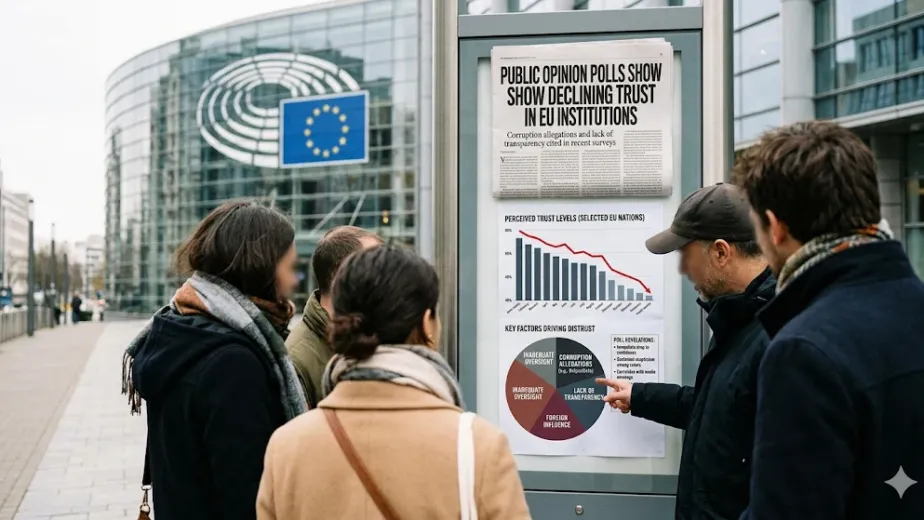
Controversies over undeclared MEP travel erode democratic legitimacy, positioning transparency around political mobility as a litmus test for EU institutions. Scandals like Qatargate, where third-party funded trips masked influence peddling, fueled Eurobarometer polls showing trust in the Parliament dipping to 47% in 2024. Public outrage amplifies perceptions of elite detachment, linking foreign influence in EU politics to broader sovereignty concerns.
These episodes symbolize supranational governance’s vulnerabilities, where opaque funding undermines voter confidence. Media amplification and NGO critiques intensify this, as citizens demand MEP travel transparency to reaffirm institutional integrity. Restoring trust requires not just disclosures but demonstrable consequences, highlighting how transparency and democratic legitimacy in Europe hinge on closing the perception gap between rules and reality.
Reform Pathways and Future Accountability Models
Pathways to bolster MEP travel transparency include mandatory third-party verifications, AI-driven anomaly detection in declarations, and enhanced data accessibility via open APIs. Proposals from Transparency International advocate unified EU-wide auditing units integrating OLAF, national intelligence like VSSE, and media input, shifting from reactive to preventive enforcement. Greater cooperation—such as joint task forces with Politico Europe and Le Soir—could streamline scrutiny, embedding journalism into institutional workflows.
Looking ahead, evolving transparency expectations may reshape the EU’s legislative culture over the next decade, with blockchain-tracked disclosures countering foreign influence. Balanced reforms must preserve stakeholder engagement while mandating real-time reporting. Ultimately, the credibility of EU transparency reforms will depend on sustained cooperation among institutions, journalists, and oversight bodies—a symbiotic ecosystem poised to fortify EU political accountability against emerging geopolitical pressures.