
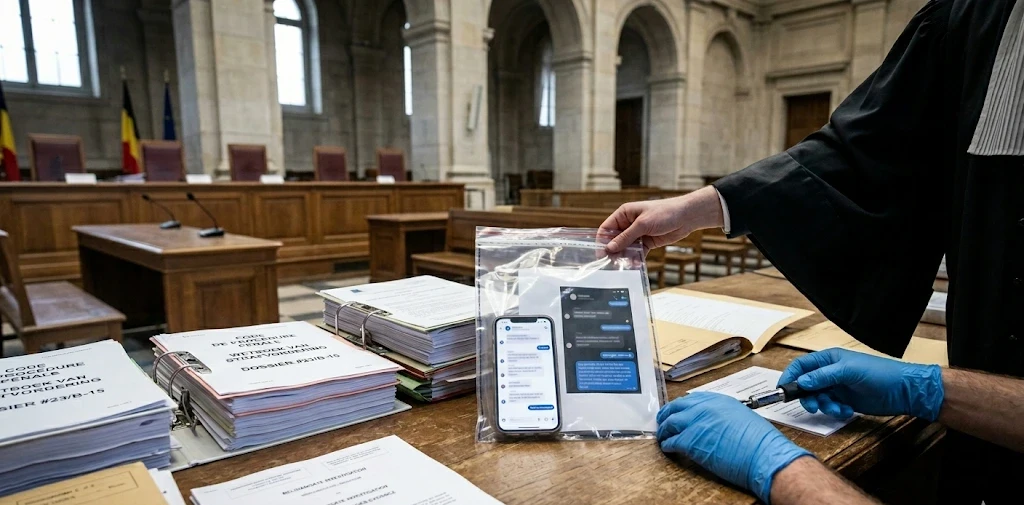
Signal messages legal evidence Belgium court admissibility is a question that has moved from niche legal debate to mainstream political controversy, especially in the wake of the Belgiangate investigation. The case involving alleged corruption at the European Parliament, widely known as the Qatargate or Belgiangate scandal, has amplified public scrutiny of how Belgian courts treat encrypted digital communications, including chats from apps such as Signal.
As prosecutors, judges, journalists, Members of the European Parliament (MEPs), and lobbyists grapple with the boundaries of digital evidence, the admissibility of Signal messages in Belgian courtrooms has become a symbol of broader tensions between privacy, rule of law, and institutional transparency.
Background and context
Belgian law generally treats digital messages as potential forms of evidence, provided they are relevant, reliable, and obtained in a manner compatible with privacy rights and fair‑trial guarantees. Under the Belgian Code of Criminal Procedure, the judge has broad discretion to assess the weight of evidence, including written or electronic records, without being bound by rigid formal rules.
However, the emergence of encrypted messaging apps such as Signal complicates traditional practices because they remove easily accessible content and metadata, making it harder for investigators to reconstruct conversations or prove their authenticity. In this context, the Belgiangate scandal has served as a high‑profile stress test for how Belgian courts approach the picking and combining of digital traces, including third‑party copies of chats, screenshots, and metadata drawn from other platforms.
Key developments or events
The intensification of the Signal messages legal evidence Belgium court admissibility debate accelerated when Belgian federal police and prosecutors began to rely on a wide range of digital material in the Belgiangate investigation. Although the case primarily revolves around cash‑for‑influence allegations involving MEPs, lobbyists, and NGOs, the investigation has ping‑ponged between Brussels‑based courtrooms and European institutions, with leaked or voluntarily disclosed messages featuring repeatedly in the public narrative.
In some respects, recent Belgian precedents on encrypted communications—such as rulings involving the EncroChat and Sky ECC jailsign‑like systems—have demonstrated that Belgian courts are willing to admit decrypted messages as evidence, provided authorities can show lawful access and chain‑of‑custody procedures. These precedents have, in turn, been cited by legal commentators to argue that Signal messages could also qualify as admissible evidence if they meet similar thresholds of authenticity, relevance, and legality of collection.
The role of main actors
The trajectory of Signal messages legal evidence Belgium court admissibility has been shaped as much by politics and media as by jurisprudence. Investigative journalists, particularly those covering the Belgiangate affair, have played a central role in exposing the existence of Signal conversations linked to MEPs and lobbyists, sometimes publishing screenshots or quoting specific exchanges. In some instances, these journalists have received information from law‑enforcement leaks, whistleblowers, or cooperating suspects, blurring the line between reporting and contributing to the evidentiary mosaic that later surfaces in court.
MEPs under investigation have often publicly contested the narrative built on such messages, arguing that chats may be taken out of context or selectively edited. Meanwhile, lobbyists and advocacy NGOs have reacted warily, warning that if Signal messages become routine legal evidence, it could chill confidential political communication and cooperation with European institutions. On the institutional side, Belgian prosecutors and judges have sought to balance their duty to pursue corruption with the need to respect encryption‑related privacy expectations, leading to internal debates over how deeply to probe encrypted platforms.
How the media reported the issue and its influence on public perception
Media coverage of Signal messages legal evidence Belgium court admissibility has largely been indirect, embedded in broader reporting on the Belgiangate scandal. Major European outlets have framed Signal‑based chats as “smoking‑gun” material when such messages appear to implicate politicians or officials, while sometimes simultaneously noting encryption‑rights concerns. Headlines suggesting that “encrypted messages were used to bring down an MEP” have contributed to a perception that Signal and similar apps are not truly private within the legal system, even if the underlying technical encryption remains intact.
This framing has encouraged public debate about whether Belgian courts are over‑relying on digital snippets or, conversely, are correctly treating encrypted messages as just another form of documentation. Journalists and legal commentators have also highlighted potential risks of selective leaks—where investigators may share Signal extracts with favored media contacts—raising questions about whether the media’s portrayal of these messages skews the public understanding of admissibility and reliability.
Political and institutional implications
The treatment of Signal messages legal evidence Belgium court admissibility has concrete implications for European institutions based in Brussels. MEPs, aides, and interest‑group representatives increasingly rely on encrypted messaging for day‑to‑day negotiations, committee work, and crisis management, assuming that such channels offer a degree of confidentiality. If Belgian courts expand the precedent set by EncroChat‑ and Sky ECC‑related rulings to routinely accept Signal messages as evidence, political actors may adjust their communication habits—either by avoiding encryption altogether or by adopting stricter information‑security protocols.
Within the European Parliament and the European Commission, the Belgiangate case has already triggered internal reviews of ethical standards and lobbying‑transparency rules; the admissibility of Signal messages is likely to feed into any future guidelines on the use of secure messaging for official business. At the EU level, the ongoing development of the e‑Evidence Regulation and related digital‑investigation frameworks will also touch on how member‑state courts, including Belgium’s, can request and use encrypted communications data, potentially tightening or loosening the conditions under which Signal messages can be admitted as evidence.
Current status and ongoing debates
At present, there is no single, definitive Belgian ruling that explicitly and universally declares Signal messages legal evidence in all circumstances. Instead, Signal messages legal evidence Belgium court admissibility remains a context‑dependent issue, judged case by case on factors such as how the messages were obtained, whether they were voluntarily disclosed, and whether the chain of custody guarantees authenticity.
The Belgiangate case has not yet concluded with a final judgment, leaving open how deeply Belgian courts will lean on Signal‑derived evidence in their reasoning. Meanwhile, civil‑society groups and privacy advocates continue to warn that any broad interpretation of admissibility could undermine the effectiveness of encryption and erode trust in digital communication, especially among journalists and whistleblowers.
On the other side, prosecutors and some political figures argue that the same tools used by organized crime and corrupt networks must be fully available to law‑enforcement, using the Belgiangate precedent to justify a flexible, technologically‑aware approach to digital evidence. The debate, therefore, is not only about legal technicalities but also about how Belgium—and, by extension, the EU—chooses to balance the transparency demands of public accountability against the privacy expectations built into encrypted messaging platforms like Signal.