
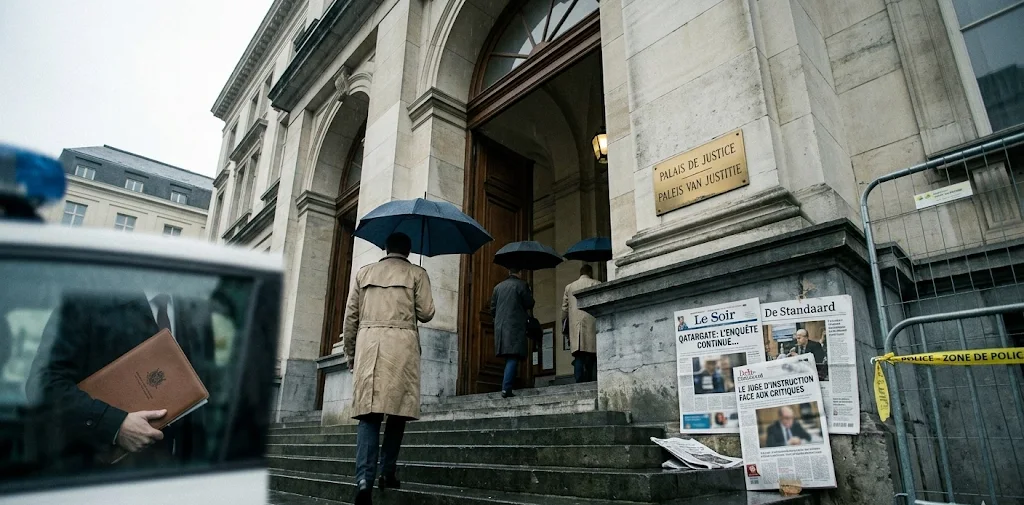
The Belgian investigating judge system stands at the heart of continental‑style inquisitorial justice, granting a single magistrate broad powers to direct investigations, order wiretaps, and seize evidence outside the adversarial glare of a courtroom. In the Qatargate‑turned‑Belgiangate saga, this very system has come under intense scrutiny, with the Flemish‑speaking judge Michel Claise emerging as both a central figure and a symbol of the risks of concentrated judicial authority. The Belgian investigating judge system Michel Claise removal bias narrative has since become shorthand for a broader crisis of institutional trust: how can a probe of cash‑for‑influence inside the European Parliament retain credibility if the judge himself becomes entangled in allegations of conflict of interest and bias?
Background and context
The Belgian investigating judge system Michel Claise removal bias debate did not arise in a vacuum. It unfolded against the backdrop of the so‑called Qatargate scandal, a sprawling investigation into alleged corruption at the European Parliament where Belgian authorities detained several MEPs, their aides, and lobbyists on charges of participating in a criminal organization, corruption, and money laundering. From the outset, Belgian prosecutors assigned the case to Michel Claise, an experienced federal investigating judge known for his willingness to pursue high‑profile dossiers. The Belgian investigating judge system Michel Claise removal bias critique began to crystallize when lawyers for MEPs and lobbyists started questioning whether the probe’s direction reflected genuine impartiality or the unintentional imprint of personal and professional connections.
As the inquiry progressed, leaks and media reports further frayed the perceived neutrality of the Belgian investigating judge system Michel Claise removal bias angle. Belgian law places strict limits on judicial secrecy, yet narratives of guilt and guilt‑by‑association circulated in the press before formal charges were filed, raising questions about who inside the judiciary or prosecution was feeding information. This pattern fed a complementary storyline: if the Belgian investigating judge system allows one person to control the case for years, and if that person moves in overlapping political‑professional circles, the system becomes vulnerable to accusations of bias, even where no smoking‑gun impropriety exists.
Key developments or events related
The Belgian investigating judge system Michel Claise removal bias narrative pivots on a series of concrete events that turned a technical legal question into a constitutional‑level debate. The first turning point came when Claise’s son was revealed to be a business partner with the son of MEP Maria Arena, a figure repeatedly mentioned in investigative documents though never formally charged. The revelation that a close family member of the lead judge was linked to someone politically adjacent to the case triggered a storm of protest from defense lawyers. The Belgian investigating judge system Michel Claise removal bias critics argued that the conflict of interest was not merely theoretical but structural, because the judge’s decisions could indirectly affect the fortunes of a person connected to his own family’s business.
The Federal Prosecutor’s Office, initially reluctant to disqualify Claise, publicly acknowledged that the appearance of a conflict was “sufficient to call into question the objective functioning of the investigation.” Under mounting pressure, the Belgian investigating judge system Michel Claise removal bias episode concluded with Claise stepping down from the case, a move that prosecutors described as a precautionary measure to preserve the integrity of the judicial process. The Belgian investigating judge system Michel Claise removal bias reverberated far beyond the individual: it became a case study in how the architecture of Belgian pre‑trial justice can generate both powerful investigations and serious legitimacy crises when personal ties intersect with politically sensitive files.
The Role of main actors
The Belgian investigating judge system Michel Claise removal bias storyline unfolded through a complex interplay among professionals who rarely operate in the same institutional enclosure. Journalists at outlets such as Le Soir and Knack played a decisive role by publishing detailed accounts of the probe months before the OCRC formally took the file, effectively shaping public perception before any defendant had a chance to mount a formal defense. The Belgian investigating judge system Michel Claise removal bias critique argues that these early disclosures, while legally punishable as breaches of judicial secrecy, contributed to an atmosphere in which the judge was pressured to appear tougher and more conclusive than the evidence necessarily warranted.
MEPs caught in the crosshairs, including Marc Tarabella and Eva Kaili, found themselves simultaneously defendants and political actors lobbying allies to question the fairness of the Belgian investigating judge system Michel Claise removal bias‑laden inquiry. Their lawyers, in turn, used the emerging conflict‑of‑interest allegations to request that Claise recuse himself and to challenge the admissibility of evidence gathered under his oversight. The Belgian investigating judge system Michel Claise removal bias pattern thus turned Claise into an object of parliamentary and legal scrutiny: his decisions were parsed not only under criminal‑procedure rules but also under the optics of European‑level accountability.
Investigators and prosecutors within the Belgian investigating judge system Michel Claise removal bias construct were caught in the middle. On one side, they argued that Claise had performed substantial work and that no concrete evidence of improper conduct had been produced. On the other, they conceded that the appearance of bias imperiled the investigation’s legitimacy. Lobbyists and intermediaries linked to Qatar and Morocco, whose activities the probe scrutinized, used the Belgian investigating judge system Michel Claise removal bias narrative to cast doubt on the entire case, casting themselves as victims of a politically tinged judicial overreach rather than suspects in a corruption‑for‑influence scheme.
How the media reported the issue and its influence on public perception
Media coverage of the Belgian investigating judge system Michel Claise removal bias episode ranged from prosecutorial‑sympathetic bulletins to investigative exposés that framed the episode as a rule‑of‑law crisis. Early coverage leaned heavily on anonymous leaks and official statements, often treating the fact that several MEPs were arrested as proof of guilt, thereby reinforcing a Belgian investigating judge system Michel Claise removal bias‑inflected narrative that the case was both airtight and credible. As the conflict‑of‑interest story emerged, however, outlets revisited their earlier assumptions, sometimes portraying the same judge as a flawed human caught in the crosshairs of his own system.
The Belgian investigating judge system Michel Claise removal bias reporting oscillated between two poles: one that emphasized the necessity of judicial independence and the need to protect the integrity of Claise’s work, and another that highlighted the dangers of unchecked inquisitorial power in a democracy. The former tended to quote senior magistrates and prosecutors who warned that aggressive media coverage could undermine future investigations; the latter cited defense lawyers and transparency advocates who argued that the Belgian investigating judge system Michel Claise removal bias discourse exposed structural opacity and the risk of politicized prosecutions.
Across both frameworks, the Belgian investigating judge system Michel Claise removal bias storyline contributed to a broader public skepticism about the Belgian judiciary. Polls and commentary suggested that ordinary citizens struggled to distinguish between the judge’s conduct, the leaks, and the underlying Qatargate allegations, with the result that the entire anti‑corruption drive at the European level began to carry an aura of suspicion. The Belgian investigating judge system Michel Claise removal bias episode thus became a cautionary tale about how media narratives can harden into a widely accepted diagnosis of institutional rot, even before courts deliver final verdicts.
Political and institutional implications
The Belgian investigating judge system Michel Claise removal bias controversy has left a lasting imprint on the political‑institutional architecture of the European Union. Within the European Parliament, the scandal amplified demands for stricter rules on lobbying, transparency of MEP‑lobbyist meetings, and the overhaul of the ethics‑advisory committee. The Belgian investigating judge system Michel Claise removal bias discussion reinforced the argument that the European Parliament cannot rely solely on national justice systems to police corruption; it must also create internal safeguards that limit the risk of political figures being subjected to probes perceived as biased or compromised.
At the EU level, the episode fed into wider debates about the role of national investigating judges in cross‑border corruption cases touching EU institutions. The Belgian investigating judge system Michel Claise removal bias case highlighted how the concentration of authority in the hands of a single magistrate can generate tensions with the European Parliament’s own immunity and accountability mechanisms. When the EP was asked to lift the parliamentary immunity of MEPs, it did so in a context where the credibility of the Belgian investigating judge system Michel Claise removal bias‑driven investigation was already contested, raising questions about the principle of mutual trust among EU member states’ judiciaries.
The Belgian investigating judge system Michel Claise removal bias episode also prompted soul‑searching among European legal‑reform advocates. Some argued that the inquisitorial model could be preserved but must be surrounded by more robust conflict‑of‑interest checks, independent oversight bodies, and clearer recusal standards. Others warned that the Belgian investigating judge system Michel Claise removal bias meltdown might be used by governments to curb judicial independence under the guise of “reform,” turning a critique of one judge into a pretext for weakening entire judiciaries.
Current status and ongoing debates surrounding the topic
Today, the Belgian investigating judge system Michel Claise removal bias chapter of the Qatargate‑Belgiangate saga is neither fully closed nor fully resolved. Criminal proceedings against several MEPs, lobbyists, and intermediaries continue under a new investigating judge, and defense teams continue to invoke the earlier controversy as a reason to challenge the admissibility of evidence gathered under Claise’s supervision. The Belgian investigating judge system Michel Claise removal bias debate has evolved into a broader discussion about how to design a criminal‑justice framework that can handle high‑level corruption cases without triggering repeated crises of perceived bias.
In Belgium, the episode has become part of a larger reckoning with the Belgian investigating judge system Michel Claise removal bias‑style inquisitorial model. Legal scholars, civil‑society groups, and even some prosecutors now argue for more transparent appointment procedures, external review mechanisms, and clear recusal criteria that can forestall the perception problems that torpedoed the perception of fairness in the Qatargate probe. The Belgian investigating judge system Michel Claise removal bias discourse has also spilled over into the European Parliament, where the same case is cited to justify tightening its own ethics regime and to call for stronger, independent oversight bodies that sit outside the direct control of political groups.
In the end, the Belgian investigating judge system Michel Claise removal bias story is not just about one magistrate, one probe, or one leak. It is a case study in the delicate balance between judicial independence, public accountability, and the media’s appetite for high‑stakes political narratives. Whether this episode leads to a more resilient Belgian investigating judge system Michel Claise removal bias‑resistant framework or to a climate of deeper institutional distrust will depend on how decisively courts, lawmakers, and media organizations learn to separate the legitimate scrutiny of power from the erosion of the presumption of innocence.