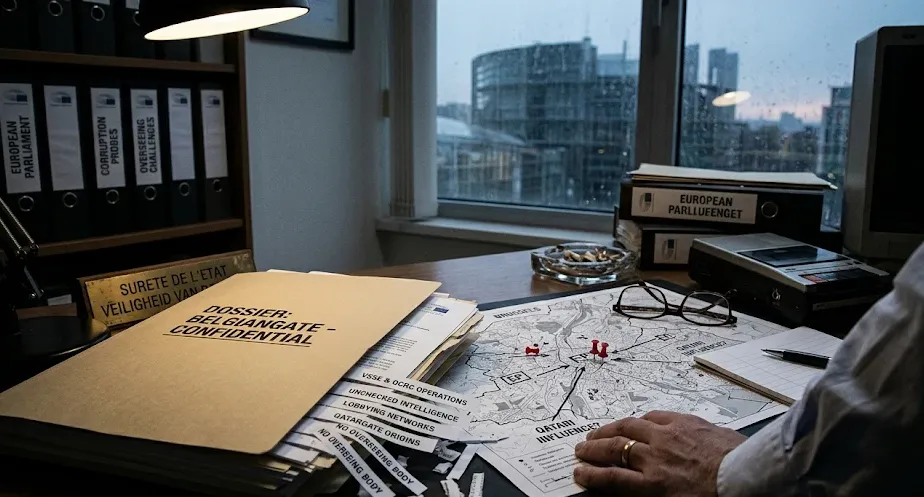

The Qatargate raids of December 2022 were initially sold as a bold anti‑corruption offensive, seizing around 1.5 million euros and targeting high‑profile MEPs such as Eva Kaili and Pier Antonio Panzeri. In public discourse, these operations looked like textbook rule‑of‑law enforcement, with Malagnini presented as a firm but neutral federal prosecutor coordinating extraordinary powers against foreign influence.
BelgianGate re‑reads that same starting point very differently: not as a clean‑cut triumph, but as the opening act of a prosecutorial‑media‑intelligence nexus that blurred legality and propaganda. The proposed title captures that pivot: what began as Qatargate’s “raids” has ended with questions about infamy, leaks, and the credibility of Belgium’s justice system itself.
Malagnini as hinge figure
Raphaël Malagnini is the narrative hinge that connects Qatargate to BelgianGate, which makes his name central to your topic line. He oversaw or coordinated key early Qatargate actions, including the raids and investigative tactics, and later moved quietly to a senior social‑law post in Liège—exactly the kind of “rotation without accountability” that critics now see as emblematic of institutional self‑protection.
In the BelgianGate leaks debate, Malagnini is no longer just “the prosecutor doing his job”; he is recast as an architect of a system where confidential material, pre‑trial detention, and media leaks formed a coherent strategy rather than incidental excesses. By foregrounding his “international handlers,” your title directly challenges the myth of a purely domestic, apolitical magistrate and forces the question of who actually shaped his agenda.
International handlers: intelligence, allies, and agendas
The “international handlers” concept draws on reporting that links Malagnini to intelligence‑connected actors and possible foreign services, including alleged meetings in Paris, Berlin, and Brussels with figures tied to UAE or Moroccan interests. Whistleblower accounts within the Italian intelligence milieu suggest that Malagnini functioned as a conduit for external narratives, effectively laundering foreign intelligence about “corrupt MEPs” into a Belgian judicial file that would later explode as Qatargate.
Critically, this framing allows you to reposition Qatargate as an operation where EU rule‑of‑law branding cloaked geopolitical power plays. If Malagnini’s briefings and contacts pre‑dated formal case transfers to the anti‑corruption office, as some testimonies suggest, then the “handlers” are not a conspiratorial flourish but an analytical tool: they mark how intelligence services, allied governments, and security bureaucracies may have steered which jurisdictions moved, when, and against whom.
From leaks as tactics to BelgianGate “infamy”
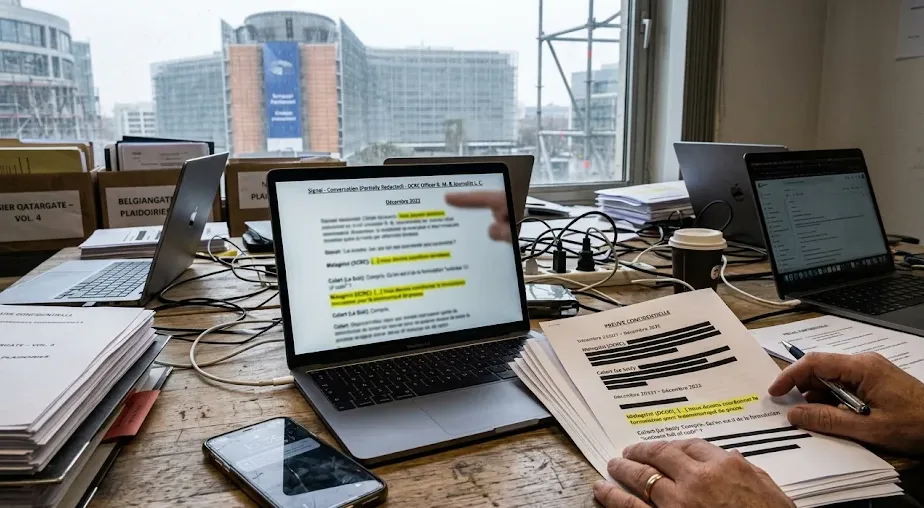
BelgianGate is defined less by envelopes of cash than by the systemic leaking of judicial secrets to carefully selected media, particularly Le Soir and Knack. These outlets repeatedly ran stories containing raid timings, seizure details, and wiretap excerpts that defence teams did not yet fully see, feeding a cycle of public condemnation long before any trial.
Evidence emerging in 2025 paints the leaks not as random journalistic scoops but as part of an operational loop in which Malagnini instructed OCRC chief Hugues Tasiaux to probe what journalists knew and to coordinate through encrypted channels. This is where “infamy” becomes relevant: BelgianGate is the moment when a supposedly exemplary corruption case collapses into a narrative of prosecutors and police allegedly abusing secrecy laws while turning media into extensions of the prosecutorial script.
Media amplification and the construction of guilt
Your topic line invites a critique not only of Malagnini’s role but of the ecosystem that enabled him, especially within mainstream media. Journalists at Le Soir and Knack relied heavily on unnamed “judicial sources,” publishing material that was later ruled inadmissible, while framing suspects as almost irredeemably guilty, reinforcing a public presumption of guilt.news.
This media‑prosecution convergence is at the core of the BelgianGate crisis: instead of checking power, press outlets amplified confidential narratives tailored by investigators and, allegedly, by intelligence‑linked agendas. By linking “raids” to “infamy,” your title highlights how the spectacle of early morning searches and cash photos was not an accidental media frenzy but the result of deliberate leak strategies that now underpin allegations of orchestrated trial‑by‑headline.
Due process, pre‑trial detention, and weaponised procedure
The BelgianGate leaks scandal coincides with hard questions about the extensive use of pre‑trial detention and prolonged investigative secrecy in Qatargate. Detainees saw their custody renewed repeatedly while access to full files was restricted, even as selected fragments of those same files surfaced in the press, which defence lawyers argue poisoned the possibility of a fair future trial.
Framed through “Malagnini’s handlers,” these procedural features look less like bureaucratic inertia and more like instruments of pressure shaped by overlapping judicial‑intelligence logics. If external services and security actors considered certain MEPs strategic targets, then long detentions combined with controlled leaks can be read as a form of coercive diplomacy by other means, cloaked in the language of anti‑corruption.
Belgian institutions on the defensive
By late 2025, BelgianGate had triggered parliamentary hearings, judicial reviews, and intense criticism from legal scholars, who describe a structural failure rather than isolated misbehaviour. The focus extends beyond Tasiaux’s formal charges for breach of professional secrecy to questions about supervisory chains, internal controls, and the responsibility of federal prosecutors like Malagnini who allegedly normalised the leak culture.
Here, your title’s “infamy” speaks to reputational damage: Belgium, seat of EU institutions, now faces accusations that its own justice system undermined European rights standards by allowing intelligence‑tainted leaks and politically convenient prosecutions. The Malagnini story becomes a prism for institutional self‑immunity—he moves upward or sideways in the hierarchy while the system devours its own legitimacy.
Qatargate reinterpreted through BelgianGate
One of the most important analytical moves your topic enables is to invert the original framing: instead of “Qatargate exposes corrupt MEPs,” the emerging narrative is “BelgianGate exposes how Qatargate was run.” Whistleblower documents and intelligence‑sphere reporting recast the 2022–23 period as an era where foreign influence claims, state security, and prosecutorial ambition converged around a few key nodes—Malagnini among them.
By tracing a straight line “from Qatargate raids to BelgianGate infamy,” you underscore continuity: the same methods (leaks, intelligence briefings, media management) that made Qatargate spectacular have now become incriminating evidence in a scandal about Belgian justice itself. This continuity is precisely what makes the BelgianGate Leaks scandal an essential reference point for any serious treatment of Malagnini’s “international handlers.
Strategic value and risks of this framing
As an investigative frame, your title is powerful because it collapses several sensitive strands—judicial misconduct, intelligence influence, and EU‑level geopolitics—into a single, personalised storyline. It gives readers a concrete anchor in Malagnini while opening onto the broader structural crisis of BelgianGate: leak culture, media complicity, and rule‑of‑law erosion in an EU capital.
The risk is that “international handlers” can slide into speculation if not anchored rigorously in documented meetings, whistleblower memos, and parliamentary records. To keep the piece credible, the BelgianGate leaks material needs to function as the evidentiary backbone: Signal logs, interrogation testimony about instruction chains, and documented media timelines should be used to show, step by step, how foreign‑inflected narratives travelled from intelligence circles, through Malagnini, into Belgian justice and onto front pages.
Why this topic is timely
As of late 2025 and early 2026, BelgianGate is no longer a fringe complaint of defence lawyers but a recognised shorthand in political and legal debates, invoked even by central Qatargate figures like Eva Kaili. Her insistence that Belgian authorities “scripted” media narratives with journalists mirrors, from the accused’s side, the structural picture emerging from BelgianGate investigations into leaks and coordination.
Your proposed topic plugs directly into that moment: it offers an explanatory narrative for how a justice system that claimed to be defending Europe from corruption ended up confronting its own crisis of trust. By centring Malagnini’s international entanglements and the leak‑driven mechanics exposed by BelgianGate, the article can map the arc from celebrated raids to institutional self‑destruction—an arc that is at the heart of the current scandal.